Evolutionary Tree Project – Day 2

EvTreeD2

Summary:
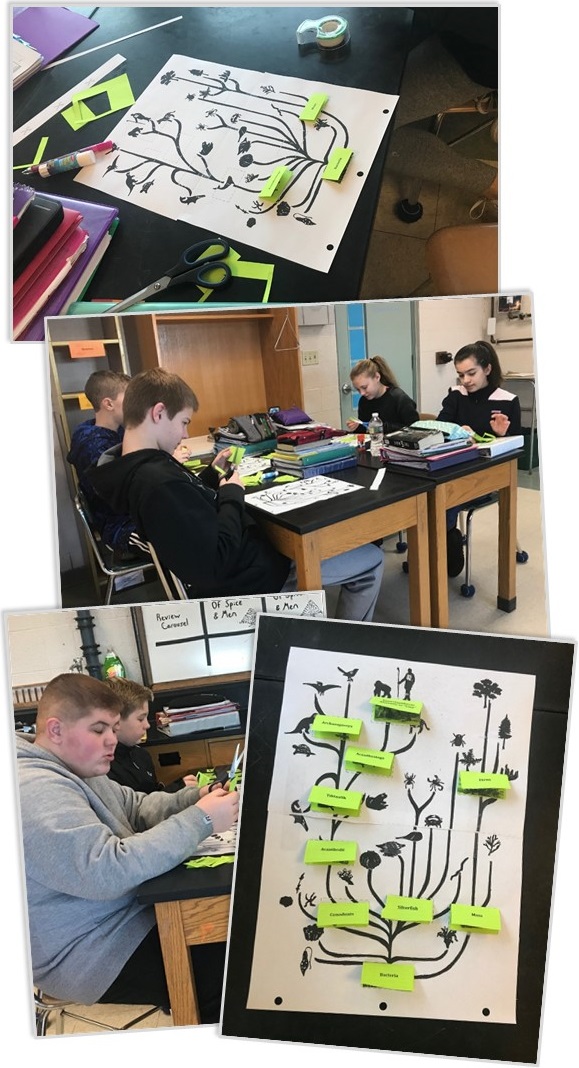
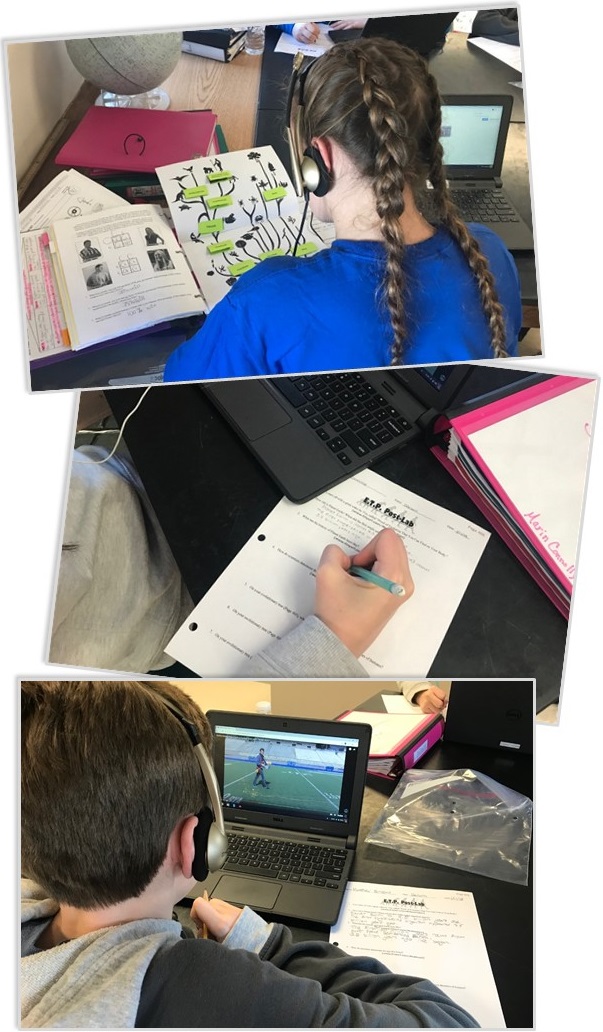
Students started off today by finishing their evolutionary trees. Then they did a post-lab assignment. It was really a mix of a regular post-lab and a webquest (or something like that). It asked them to watch a few videos, learn a bit about Earth’s history, and learn a bit about fossils. Then students had to take out their own evolutionary tree, use it to answer a few questions, and research our ten transition species.

Resources:
January 11 – ETP Post-Lab (pg406).docx

Evolutionary Tree Project – Day 1

EvTreeDay1

Summary:
Today was the first day of our “Evolutionary Tree Project.” Students put together a blank copy of a phylogenetic tree, cut it out, taped it together, and added it to their binder. Then they added ten “transition species.” These are species that, while perhaps they are no longer living, were part of an evolutionary transition from one species to another. These included moss, ferns, archaeopteryx, and even the eel-like conodronts. They cut out each transition species card, folded it, and glued it onto their tree. You can see an example of the finished product above. It wasn’t perfect. For example, whales are in the wrong spot, and there are lots of species missing from our tree. But still, it provides a good snapshot of how evolution has shaped the history of life on Earth.

Resources:
January 10 – Evolutionary Tree Project (pg405).pptx
January 10 – Ten Transition Species.pptx

The Fossils Carousel

This slideshow requires JavaScript.

Summary:
After we finished learning about Darwin’s Theory, it was time to start looking at some evidence. If Darwin was right, then we should be able to find evidence of species gradually (or perhaps suddenly) evolving to fit their environments. Today students rotated through seven different stations, observing seven different groups of fossils. Their goal was to put each group in the order in which it evolved.

Most students found that it wasn’t that hard. You could usually find some prehistoric animal, some transition species, and then some more modern animal. Students took notes on their theories (on Page 404) and then they began to discuss why they might have evolved. Why was it an advantage for some burrowing lizards to lose their legs? Why was it an advantage for humans to develop larger, less-protected skulls? And what really is a horses hoof? Fossils can teach us all of these things and more.

Resources:
January 9 – Fossils Carousel (pg404).docx
January 9 – Fossils Carousel Timer.pptx
January 9 – Fossils Print-Outs.pdf

Stick-Bug Simulation

SBS

Summary:
We started off today with a 10-minute review of Darwin’s Theory. We discussed it in groups and then defined it as a class. Then we played a classic game called the Stick-Bug Simulation. It’s an old computer game produced by FOSS (click here for access).  Students take turns hunting stick bugs in different environments. And as the game goes along the stick bugs evolve. The winner is the student who is able to kill the most. Meanwhile the whole class copies down the data. After we finished, I awarded prizes for the winning students and we answered questions about each time we completed the simulation. For more information, see the attachments below.

Resources:
January 4 – Stick Bug Simulation (pg403).docx
January 4 – Stick Bug Extra Credit.pptx
January 4 – Stick Bug Posters.pptx

Darwin’s Theory

DarwinsTheory

Summary:
I started off today by checking last night’s homework, the Hawks & Field Mice Post-Lab assignment. Then we moved on to perhaps the most important lesson in Unit 4: Darwin’s Theory. We discussed Darwin’s history as a young naturalist, his voyage to the Galapagos, and all of the animal and plant life he observed. In particular, we focused on his observations of the finches and how they gave rise to his Theory of Natural Selection. I tried to explain to the kids that, quite simply, “if you are born with a genetic trait that helps you survive and reproduce, there’s a good chance that trait could spread to the entire species.” This is true in finches, it’s true in stick bugs, and it’s even true in humans. We then moved on to discussing the modern interpretation of Darwin’s theory, the interrelatedness of species, scientific consensus, and the three factors that are required for evolution.

Resources:
January 3 – Darwin’s Theory (pg402).pptx
January 3 – On the Origin of Species (adapted).docx

Hawks & Field Mice Lab

.
Summary:

Before getting into the heart of Unit 4, we took a day to complete one of my favorite lessons: the Hawks and Field Mice Lab. The rules of the game are simple. Each student is a predator. Their prey are little paper mice* that come in three colors: green, yellow, and black. During each round of the game, the students get 60 seconds to run walk up onto the stage and find a mouse. Between each round, the mice reproduce. Meanwhile, the entire class keeps track of the populations.

HAFM

The results are exactly what you’d expect. The black mice are able to blend in with the dark  auditorium stage. The yellow and green mice are found more quickly and more often. After a few rounds, the majority of the surviving mice were black. And just like in real life, when mouse reproduction was simulated, most of the mouse babies were also black.

But a better way to explain the lab would be to say that “the mice evolved.” Over time, the population of mice developed camouflage. Our paper mice were not aware that they were developing camouflage, nor were our human predators. And yet, by the end of the game, the population seemed to fit its environment almost perfectly. Before the lesson, I tell the students it’s a lab about the predator/prey relationship. It’s not! It’s really a lab about evolution. The students just don’t know it yet.

*The game works even better outdoors with multicolored pasta (green, yellow, orange, etc.) You throw them in the grass and the students have to find them. And of course, the green pasta always wins. But it’s January… so indoors it is!

Resources:
January 2 – Hawks & Field Mice Lab (pg401).docx
January 2 – Mice Print Outs.docx
Intro to Evolution

evolutionrevised

Summary:
I like to start off Unit 4 with a simple exercise. Students take seven common statements about evolution and try to classify them as either true of false. Then we go through a PowerPoint (posted below) and correct their answers, without going into too much detail.

  1. Evolution is “just a theory.” False. Evolution is a theory in the same way that the theory of gravity is a theory; it is a widely accepted explanation for scientific observations.
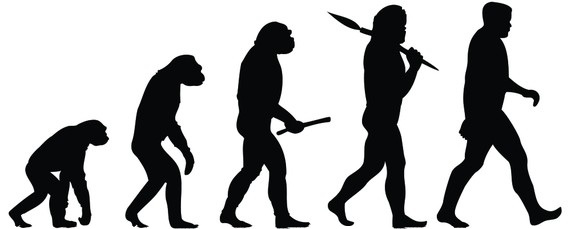
  2. Evolution explains how humans evolved from gorillas. False. Humans evolved from some sort of ancient forest ape, not any modern-day animal.
  3. Evolution is incompatible with religion. False. Even the Catholic Pope has softened his stance on evolution in recent years.
  4. Evolution is not science because it’s not observable or testable. False. We have observed evolution happen in bacteria, elephants, etc.
  5. Evolution involves organisms trying to adapt. False. Evolution happens naturally, not because of the desires of any plant or animal.
  6. Evolution happens during an animal’s lifespan. False. Evolution occurs over generations, sometimes taking millions of years.
  7. Evolution explains how life began on Earth. False. Evolution is an explanation for how life changes, not how life began. The beginnings of life are still a mystery.

Did you catch on yet? I’m hoping the students did. The seven statements above are really “common misconceptions about evolution.” All of them are false. And although they are complicated, my hope is that by the end of Unit 4, my students will be able to explain every one of them!

Resources:
January 1 – Intro to Evolution (pg400).pptx