Moons

.
Summary:
Today’s lesson came in two parts. For the first 15 minutes of class, I gave a lecture about moons. We shut off the lights, turned on our fake sun, and discussed the moon, moon phases, eclipses, and even Apollo 11 (see video above). Then students got to work on Page 514. They were asked to explain what they had absorbed about the aforementioned topics and they even did some speed and gravity calculations. Meanwhile, Mr. A walked around the room sprinkling in some mediocre moon jokes. All in all, it was a great class.

Resources:
March 1 – Moons (pg514).docx
March 1 – Moons Lecture Notes.docx
March 1 – Moons Poster.pptx
March 1 – Moons Jokes.docx

Planets


Summary:

Today we dug a little deeper into the topic of planets. Specifically, we focused on the eight planets within our solar system. We began by reviewing some of yesterdays basic classifications (stars, planets, moons, and asteroids). Then students researched facts about each planet and completed an illustration of each. A copy of the worksheet can be found below.

Resources:
February 28 – Planets (pg513).docx

The Life of a Star

loas

Summary:
We started today with a brief, 10 minute lecture on stars, using the PowerPoint below. We reviewed how the clumping of matter in space can form asteroids, planets, and if the clumps get big enough… stars! If these piles get really large, the gravity, heat, and pressure is so immense that the atoms can slam into each other with incredible force. If that happens, fusion can begin; hydrogen atoms slam into each other and fuse to become helium. And in doing so they release a ton of energy. That fusion-energy is what powers stars. Our discussion then turned to the life cycle of a star. Can atoms fuse indefinitely? Wouldn’t they eventually end up with really large atoms like iron? What happens then?

After that discussion of a star’s life cycle, students made foldables (pictured above). Once they were cut out, illustrated, and filled with notes, these became a great study guide. They walk you through the life cycle of both small and large stars, from their beginning as a stellar cloud to their most fascinating endings.

Resources:
February 27 – The Life of a Star Lecture.pptx
February 27 – The Life of a Star Foldable.docx

Forming a Solar System

FAS

Summary:
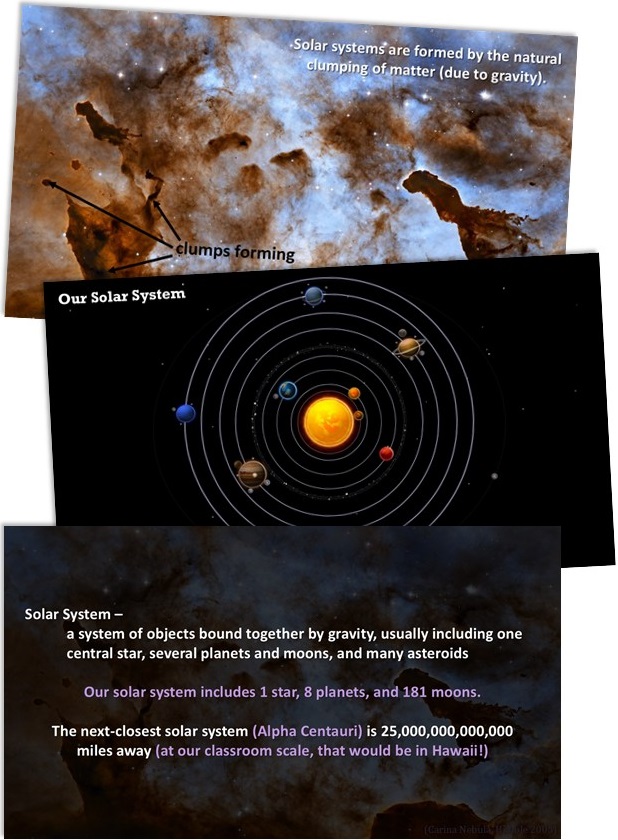
We moved on to a new topic today, and this where Unit 5 really starts to get interesting. The topic was “forming a solar system.” We discussed how the clumping of matter naturally occurs in outer space due to gravity. And how the size and composition of these clumps means that they can form asteroids, planets, moons, or even stars. We then discussed our own solar system, including it’s shape and components. At then end of class, students drew their own solar system on the back of Page 512. Both today’s notes-sheet and the PowerPoint are posted below.

Resources:
February 27 – Forming a Solar System (pg512).docx
February 27 – Forming a Solar System PowerPoint.pptx

Review Carousel

This slideshow requires JavaScript.

Summary:
Today we took a pause to review what we have learned so far in Unit 5. Students completed a Review Carousel, rotating from table to table, answering questions, and correcting their work. Topics included gravity, tides, seasons, and what life would be like on a strange mystery planet. Copies of the materials can be found below.

Resources:
February 26 – Review Carousel (pg511).docx
February 26 – Review Carousel Table Questions.docx
February 26 – Review Carousel Timer.pptx

Tides Graphing

TidesGraphing

Summary:
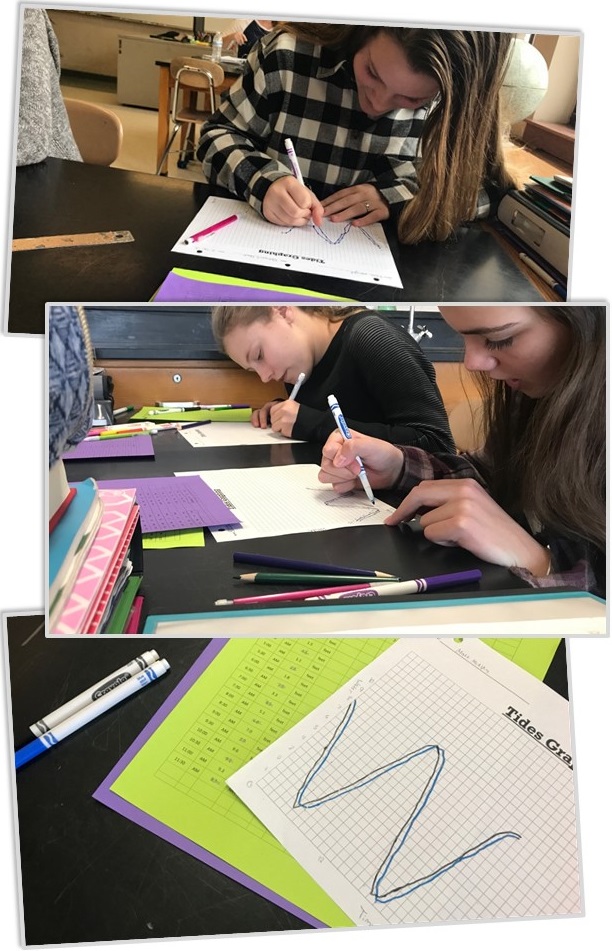
Today we reviewed what we learned yesterday about tides. The moon’s gravity lifts the ocean about +6 feet above its normal depth, the Earth rotates, and every six hours you change tides. But after this discussion, we took it to the next level. Students graphed tide data acquired from NOAA for both today’s tides and yesterday’s. Then they tried to use their graph to predict tomorrow’s tides and answered questions about why these specific tides occurred. The graph and data are posted below.

Resources:
February 16 – Tides Graphing (pg510).docx
Tides Data – Brant Rock – February 15th.pdf
Tides Data – Brant Rock – February 16th.pdf

Tides

This slideshow requires JavaScript.

Summary:
We moved on to our next topic today: tides. I gave a lecture to students, using the PowerPoint posted below, that covered quite a bit of ground. We discussed what tides are, how they are caused by the moon’s gravity, why they switch roughly every six hours, and how the sun influences things too. We also talked about a strange example, the Bay of Fundy, where tides can vary by as much ass 55 feet! Then we finished off with a quick engineering competition. The goal? Protect Marshfield from our rising tides.

Resources:
February 15 – Tides Notes (pg509).pptx