Error
This video doesn’t exist
After a long, much-needed February vacation, we continued Unit 5 today with a discussion of three of the most fascinating topics in astronomy: black holes, aliens, and asteroids. And although we have certainly touched on each of these topics before, today we dug deeper.
Black holes are a particularly popular science topic, perhaps because they’re so darn scary. Imagine an all-consuming vacuum in space so powerful that not even light can escape. That is the essence of a black hole. And although we have never observed one directly, scientists believe there is a black hole at the center of our Milky Way galaxy. In fact, there could be millions of black holes out there. MIT’s Haystack Observatory is currently hunting for black holes by looking for gravitational lensing (starlight that has been distorted by the black hole’s immense gravity).
Next, we discussed the possibility of alien life, and the odds don’t look good. Only 7% of stars are in the right place in their galaxy to support life, only 10% of planets are the right temperature, only 20% of planets are terrestrial, and only 10% of a suitable planet’s lifespan will have observable life on it. Of course, these are very rough estimates, but you get the point; the chances of flying to some new planet and discovering life on it are slim, something like 0.014%. But wait a second! Aren’t there billions of galaxies out there, made up of billions of stars, each one with orbiting planets? These are rough estimates too. But if you do the math, that would mean there are about 4,500,000,000,000,000,000 planets with aliens life on them. Those are some pretty good odds after all!
Lastly, we discussed asteroids, which are basically flying space rocks. Some of them are harmless, they burn up in the atmosphere as “shooting stars.” But others can be deadly. The asteroid that caused the extinction of the dinosaurs is believed to have been about 6 miles wide. And there are something like 150,000,000 asteroids in our solar system. Most have harmless orbits, way out at the edge of the solar system or stuck in the asteroid belt between Mars and Jupiter. But some have irregular orbits, and that makes them candidates to possibly impact Earth. Scientists use telescopes and mathematical modeling to find and predict the paths of these rogue asteroids, but it’s not easy, and some think it’s just a matter of time before the next collision. I, for one, make sure to always wear a helmet to bed, and I suggest you do the same.
February 22 – Black Holes, Aliens, and Asteroids (pg505)

 Today we started off by correcting this weekend’s HW (Skywatch). Afterwards, we went over the rules for tomorrow’s Alien Invasion Game. We walked through traveling, attacking, and mining and also went over some of the finer points of the rules. For example, you can only visit each planet once and you cannot mine and travel on the same turn. Good luck tomorrow, everyone!
 Today students researched the second of their two planets. By now, all the groups should have all eight planets covered. Remember, if you were absent at some point this week, it is your responsibility to make up the work that you missed. Your group is counting on you! The homework this weekend is the Skywatch assignment, posted below as a PDF. It consists of several review questions, a pretty scary data table, and a chance to go outside and observe the planet Jupiter.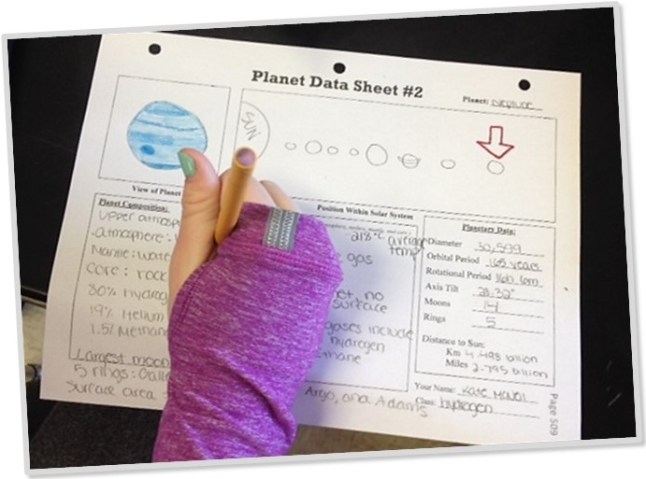
 Today students began what is perhaps the most important part of Alien Invasion Week… the research. By knowing exactly what is on each planet, and where to find it, students will have a huge advantage during the game. We began today by choosing one of our two assigned planets to focus on and then filling out a Planet Data Sheet, as seen below.
 Today we began the Unit 5 capstone project: Alien Invasion Week. The basic premise is that students will play a giant board game on the floor of the classroom. They will fly spaceships around the solar system, visiting planets, collecting resources, flying back to their base, and earning money, all while trying to avoid getting killed by the other groups.
 www.MrAscience.com