Review Carousel

RC

Summary:
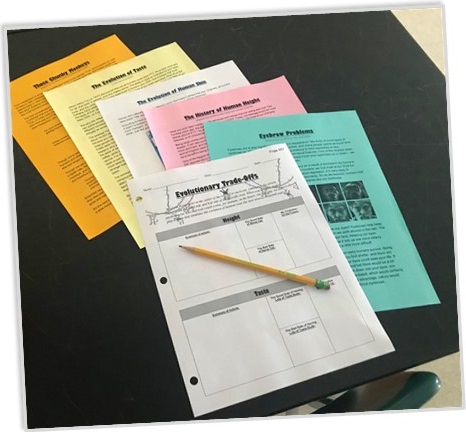
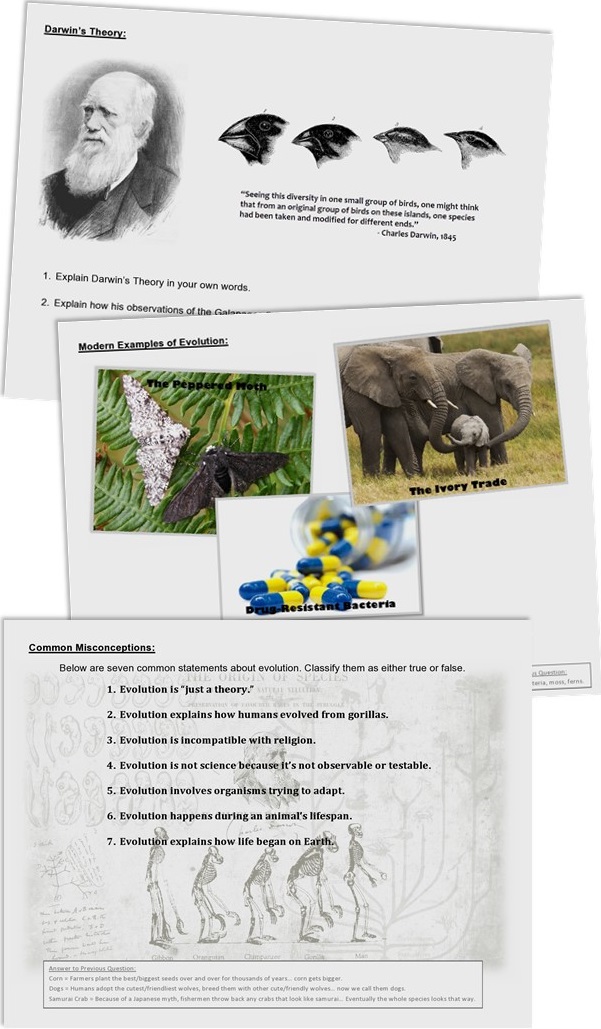
Today was a good day to pause and review. So far in Unit 4 we have learned about Darwin’s theory, the evolutionary tree, modern examples of evolution, and artificial selection. For today’s activity, students completed a “review carousel,” rotating around the room answering review questions. They spent 4-5 minutes at each table and then, upon rotating to the next table, they corrected the previous problem and moved on the another problem. Copies of the worksheet, questions, and timer are posted below.

Resources:
January 23 – Review Carousel (pg413).docx
January 23 – Review Carousel Table Questions.docx
January 23 – Review Carousel Timer.pptx
Deconstructing the Debate

This slideshow requires JavaScript.

Summary:
One of the best ways to learn something is to teach it to someone else. “While we teach, we learn,” said Seneca, the Roman philosopher. With this in mind, one of my last lessons in Unit 4 asks students to do just that.

Students played the role of National Geographic employees. Every month, National Geographic publishes a magazine full of articles, and every month people write to the magazine to comment, or compliment, or complain. The students’ job today was to respond, via email, to some of these comments. I provided them with seven different different fictional emails, each with a fake email address to go along with it. All the students had to do was write back. “No, it’s not just a theory,” they said. “Yes, we have seen it happen before,” another wrote. And “I hope you work things out with your brother,” she added.

Resources:
January 23 – Deconstructing the Debate (pg412).docx

Artificial Selection

ArtSelec

Summary:
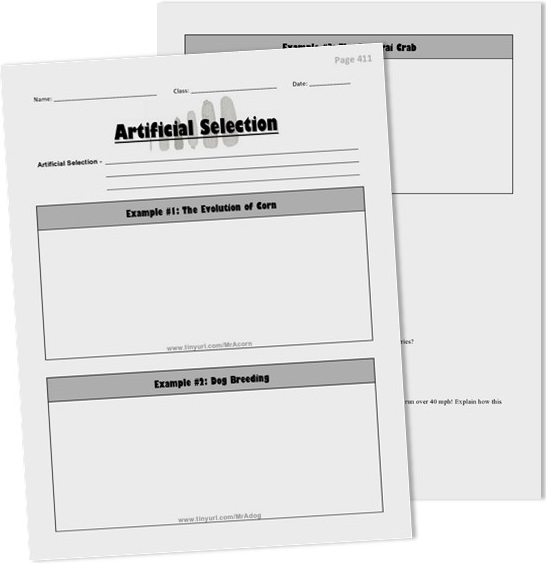
We started off today by introducing the topic of artificial selection, the idea that humans could determine the genetics of a species intentionally. We defined it as “the selective breeding of plants of animals with the hope of producing offspring the desirable traits.” But I prefer an even simpler definition: “Evolution on purpose!”

After the discussion, students researched three different examples online. They read about the evolution of corn and how it went from a small seed cluster to the massive fruit we know it as today. They learned about how dogs were actually bred (intentionally or unintentionally) from wolves. And lastly they watched a video about the samurai crab, a type of crab whose back looks remarkably like a samurai mask, that humans are thought to have influenced. In all cases, it was humans, not nature, who caused the evolution of the species.

Resources:
January 22 – Artificial Selection (pg411).docx

Evolution of Bacteria Lab

drugresistantbacteria

Summary:
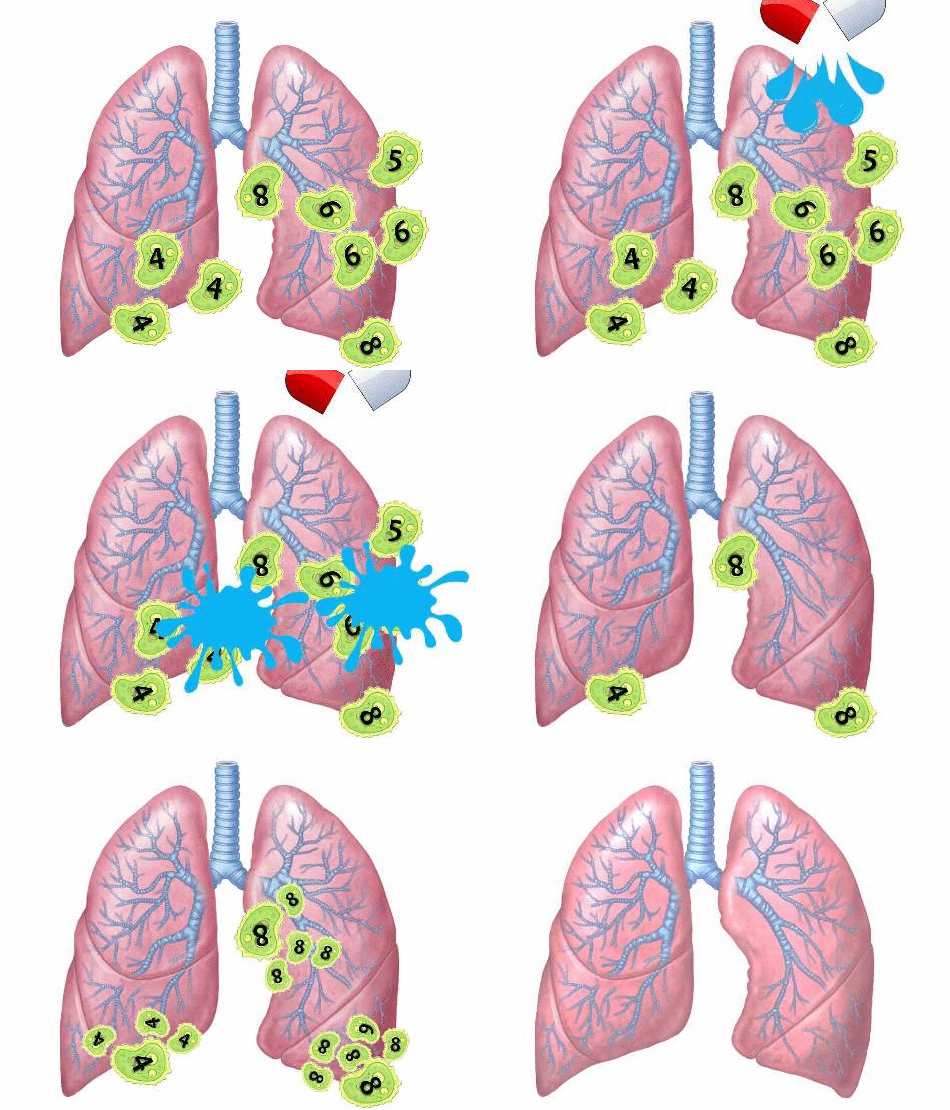
Today we completed a lab that simulated how bacteria have evolved to resist modern antibiotics. We used two dice to represent the drug penicillin. And we started off with a group of 20 strep bacteria, each one with a strength rating from 1-10. Students rolled the dice for each bacterium, and if they rolled higher than the cell’s strength rating, they successfully killed off that bacterium. After rolling for all 20 cells, students copied over the survivors and had them reproduce, as if the germs had passed on to another person. Then they repeated the process, rolling the dice, killing off some of the cells, and passing the germs on to a new person. After five rounds, the result was clear; bacteria are getting stronger! A copy of the lab can be found below.

Resources:
January 19 – Evolution of Bacteria Lab (pg410).docx
January 19 – Genetic Mutation Cards (optional).pptx

Modern Examples of Evolution

This slideshow requires JavaScript.

Summary:
Today we did a lesson on modern examples of evolution. These are examples that we humans have observed, since Darwin, that have illustrated the process of natural selection. The first example was the very famous peppered moth which evolved from white into black to help blend in with England’s industrial pollution. The second example was the ivory trade, which has forced African elephants to evolve shorter tusks. And the last example was drug-resistant bacteria, germs that have evolved to resist our antibiotics over the past 100 or so years. You can find a copy of the PowerPoint below.

Resources:
January 17 – Modern Examples of Evolution (pg409).pptx

Could We Evolve?

.
Summary:

Today we did a simulation that imagines the evolution of humans over the next thousand years. We got out our families from Unit 3 (two parents and two children for each group) and taped them to the white board. At the start, our population was roughly 30% tall, 25% dark-skinned, 25% sensitive taste, 45% slow metabolism, and 50% thick eyebrows. Then we took turns rolling dice and reading different game cards that changed our population. Some cards killed off the palest individuals due to skin cancer. Others cards added extra children to the our healthiest families. And all the while, the genetics of our population were changing. By the end of the game, the species was notably different, which got students thinking… could we evolve? Are we evolving right now?

Resources:
January 16 – Could We Evolve (pg408).docx
January 16 – Game Cards.docx

Evolutionary Trade-Offs

TradeOffs

Summary:
Today we moved on to a new topic: Evolutionary Trade-Offs. This lesson will lead directly into Monday’s lesson where we will simulate the future evolution of humans. But first I wanted to look at five different human traits and the trade-offs associated with each. I began by explaining that a trade-off is really something that has a good side and a bad side. For example, a mating call is a pretty clear trade-off. The good side is that it helps an animal find a mate to reproduce with. The bad side is that it also might alert predators to your whereabouts. So which species can afford this trade-off? It’s not the ones (like mice) who live on the forest floor. It’s the ones who are already safe up in the trees (like birds)!

Human traits involve trade-offs too. My students read five different articles (posted below), each about a different human trait. They summarized the article, figured out the good and bad side of that specific trait, and then made a prediction about how humans might evolve in the future. On Monday we will see whose predictions came true and whose didn’t.

Resources:
January 12 – Evolutionary Trade-Offs (pg407).docx
January 12 – Five Trade-Off Articles.docx