Lost in Space – Day 5

— Day 1 — Day 2 — Day 3 — Day 4 — Day 5 —

LISD5

Summary:
This was the final day of the Lost in Space project. And instead of having students complete a typical lab report, we decided to get creative. Students wrote a journal, as if they were truly lost in space during a mission to find a new planet. Their journal spanned the course of 60 days, just like the game. And they wrote about their arrival in the new solar system, what life was like in outer space, surviving attacks from enemy ships, and landing in a strange new world. For some the journey had a happy ending. They found food, fresh water, and comfortable temperatures. For others it was more somber. One student wrote “Day 60: We are attempting our landing on Planet Y. Just passed through the asteroid belt. We are really accelerating now as the gravity takes us in. It’s cloudy here. Getting dark. We should hit the surface any minute now. Still falling. Our shipf is starritng to creak… creekigndh noiseh inteh hllu…”

Resources:
March 13 – Lost in Space Journal (pg518).docx

Lost in Space – Day 4

— Day 1 — Day 2 — Day 3 — Day 4 — Day 5 —

.
Summary:
We finished the last 30 rounds of the Lost in Space game today. Each team finished probing the planets and posturing for position, and then with about three rounds remaining, Mr. A announced that it was time to land our ships. After the mad dash was over and the dust settled, students opened a box to find out what was on their planet. For some the box was empty, for others it was full of rocks. But for some, for the winning groups, the box was filled with sweet rewards. Their planets were capable of supporting life. The right temperature, a rocky surface, medium gravity, with oxygen gas and liquid water. Enjoy your treats, children. You chose well.

Resources:
March 9-12 – Lost in Space Project Materials.zip

Lost in Space – Day 3

— Day 1 — Day 2 — Day 3 — Day 4 — Day 5 —

.
Summary:
Today we played the first 30 rounds of the Lost in Space game. Students flew from planet to planet, dispatching probes, collecting data, and attacking enemy ships. Most groups made some headway, learning about the chemistry, temperature, and size of each planet. Other groups, not so much. Meanwhile team members kept a record of all the important events that happened to their group. These will be important notes for next week’s writing assignment. Tomorrow we play another 30 rounds and finish the game.

Resources:
March 9-12 – Lost in Space Project Materials.zip

Lost in Space – Day 2

Day 1 — Day 2 — Day 3Day 4Day 5

.
Summary:
Today was the second day of the Lost in Space project. We spent the first half of class going over the rules and students spent the second half of class strategizing with their teammates. The rules are fairly simple:

Goal: Find a new home-planet in this faraway solar system.

Turns: Each turn in the game will last 1:00.

Turn Options:
TRAVEL: Ships can move as many spaces as they want, up to their “Speed Rating.”
ATTACK: You can attack other nearby ships by rolling dice.
PROBE: You can use probes to research nearby planets.

Order of Turns: Groups that are attacking go first, followed by groups that are probing, followed by groups that are traveling.

End of Game: With roughly three rounds remaining, your group must decide which planet it wants to land on, fly to that planet, and land on its surface. If you choose correctly, you will win a prize.

For a full description of the rules, see the handout below. After demonstrating and discussing the rules, students worked with their teammates. They reviewed the four requirements for a habitable planet. Then they developed strategies to determine whether a planet meets those requirements. Tomorrow, each group should be ready to rock. Let the games begin.

Resources:
March 8 – Rules & Strategies (pg517).docx

Lost in Space – Day 1

— Day 1 — Day 2 Day 3Day 4Day 5

This slideshow requires JavaScript.

Summary:
Today was the first day of my favorite project of the year: Lost in Space. Students were divided into groups of 3-4. We began with a presentation introducing the premise of the project. To make a short story shorter, the project takes place in the future, each team of students represent a team of astronauts from a specific country, and the goal of each country is to search a new solar system for a potentially habitable planet. The project will last five days, and today was only the introduction.

Basically the project ends up being a giant board game on the floor of the classroom. Each team of students flies their spaceship across the game board, zooming around, probing each planet, and attacking other teams. From the probe data they collect, each team will have to deduce which planets are livable, choose one, and then land on it by the end of the game.

After today’s introductory presentation, students worked with their teams. They chose their country. They assigned each group member a specific role. They chose the type of spaceship they would like to use (they have five choices, as listed in the document below). And then finally they built a spaceship game piece. My favorite project is off to a good start.

Resources:
March 7 – Intro to Lost in Space.pptx
March 7 – Intro to Lost in Space (pg516).docx

Letters to the Past

LetterstothePast

Summary:
Today we revisited the astronomy myths from the beginning of the unit. Students reached into a box and pulled out one of the myths randomly. Their task was to write a letter back to the author of that myth. “Dear John Abbot,” one letter read, “I was impressed by how you were able to predict the tides way back then. But I want to tell you why the tides happen. It’s not because the Earth is inhaling and exhaling sea water. The real reason tides occur is because…” Students completed as many letters as possible in the 45 minute class period. This was a good chance to review all of the science that we learned in our astronomy unit, with a little dash of imagination and creativity. Tomorrow we will begin our capstone project.

Resources:
March 6 – Letters to the Past (pg516).docx

Black Holes, Aliens, and Asteroids

BHAA

Summary:
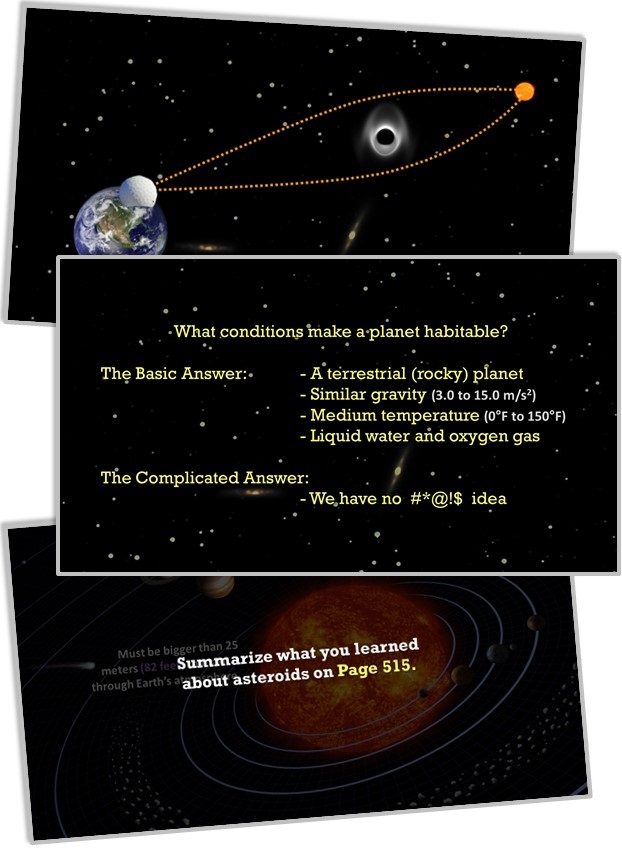
There isn’t enough time to cover every astronomy topic in Unit 5. But there was time for three more. Three of my favorites… black holes, aliens, and asteroids. Today in class, we went through a PowerPoint that discussed each of these fascinating topics. We started with black holes, a clump of matter so heavy and dense that its gravity will even suck in light. Then we moved on to alien life; to make a long story short, they’re out there! Lastly we discussed asteroids, the topic that is probably the biggest threat to Earth.

Resources:
March 5 – Black Holes, Aliens, and Asteroids (pg515).pptx