Lewis Dot Structures

When we left off on Friday, we were making full models of atoms. In order to create a Potassium atom, we would count out 19 protons, put them in the nucleus… do subtraction to figure out that there were 20 neutrons, then put them in the nucleus… count out 19 electrons and sort them into shells… two in the first shell, eight in the second, eight in the third, and one in the fourth. What a pain in the butt!

Today we discussed a quicker way. It is called a Lewis Dot Structure. First, you write down the chemical symbol. Then you put dots around it to represent the electrons in the valence shell (the outermost shell). Then you’re done. What a time-saver! We can diagram a potassium atom in ten seconds rather than ten minutes.

lewisdotstructures

Today in class, students practiced making these diagrams, and then we discussed another time-saver. Because of how the periodic table is organized, you can often use a shortcut to figure out the dot diagrams: elements in the first column get one dot, elements in the second column get two dots, and so on. But be careful, this trick only works up to element 20 and it doesn’t work for Helium.
October 19 – Lewis Dot Structures (pg211)

Atom Modeling Competition

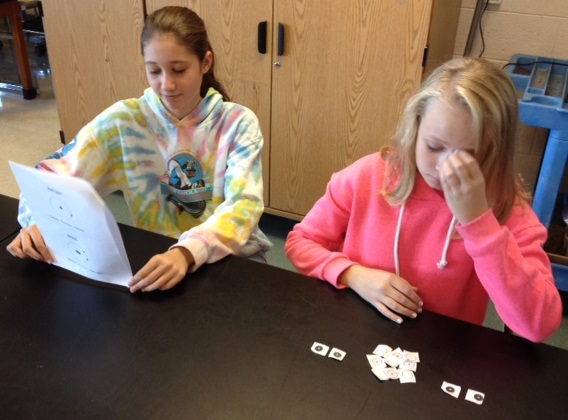
Today in class, students took part in our Atom Modeling Competition. They competed against their partner building models of atoms within the time allotted. Remember, protons are the easy ones; they are always equal to the atomic number and they go in the nucleus. Electrons are a little trickier; they are also equal to the atomic number (under normal conditions) but they must be placed in the correct shells… 2, 8, 8, 18, 18, etc. Neutrons are tricky as well. They go in the nucleus too, but to find the number of neutrons you must subtract the number of protons from the atomic mass. And always remember, guys, never trust an atom, they make up everything!

photo 2

Intro to Atom Modeling

Today was an early day, so each class only had science for about 20 minutes. After checking off the homework, Mr. A introduced tomorrow’s Atom Modeling Competition. Students will compete against their partner to build correct “Bohr Models” of atoms. The models must include the correct number of protons, neutrons, and electrons, and the particles must be placed in the correct locations. Tomorrow, students will keep score of how many they got correct and the winner will get a piece of candy for their efforts.

Neutrons

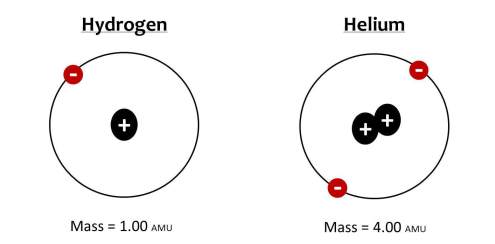
Before the 1930s, most scientists assumed that atoms were simply made of protons and electrons. So a hydrogen and a helium atom placed side by side would look something like this:

Slide1

But scientists measured the mass of a hydrogen atom to be 1.00 AMU and measured the mass of a helium atom to be 4.00 AMU. It didn’t make sense! How could the double the particle have quadruple the mass? It was almost as if something were missing…

The particles that were absent from earlier models are now called “neutrons.” It is a neutral particle with no magnetic charge and it has roughly the same weight as a proton. To figure out the number of neutrons in any normal atom, you simply take the atom’s atomic mass, round it off, and subtract the number of protons. Using this method it is easy to figure out that helium has two neutrons, but hydrogen doesn’t have any.

Slide2

Today in class, students practiced making these calculations on Page 210. When they were done, they read about the weird, wild world of isotopes (atoms who don’t have the normal number of neutrons) and their applications.

October 14 – Neutrons (pg210)

To complete tonight’s homework, please click here. Then select: 20 questions; protons, neutrons, & electrons; and select “No rounding.” After answering the 20 questions, print out your score report. You will hand it in tomorrow as your HW grade.

Protons & Electrons

In the 1800s, for the first time, scientists began to make real progress in figuring out what the world was made of. Water, it turned out, was made from hydrogen and oxygen. Salt, it turned out, was made from sodium and chlorine. But there were some substances that could not be broken apart… today, we call them elements!

The Periodic Table is simply a list of all the types of atoms that make up everything on Earth. Using those same 100+ ingredients, you can make a rock or an airplane or even a human. Understanding the Periodic Table is an essential part of studying chemistry.

Today students reviewed how to look at a square on the Periodic Table and turn it into a model of an element. Beryllium (Be), for example, has an atomic number of four. That means that its nucleus is made of four protons — otherwise it wouldn’t be Beryllium — and it also normally has four electrons which orbit the nucleus in distinct shells. A simplified model of a Beryllium atom would look like the one below.

berylliumatom

Tomorrow we will add neutrons to the mix, the particle that turned modern chemistry on its head.

October 13 – Protons and Electrons (pg209)

Mystery Mix (Day 4)

Today was the final day of our Mystery Mix experiment. After narrowing it down to the “Seven Fizzers” (the seven pairs of chemicals that bubbled when mixed with water) yesterday, students got one final chance to revisit those reactions today. They retested each of the seven, watching closely for any observational clues that might be found. They also used a thermometer today. By inserting the thermometer immediately after each reaction, students were able to measure exactly how much the temperature changed. Remember, one of the most surprising observations on Day 1 was that the reaction felt cold!

mysterymixday4

For homework, students will have to make a final decision on what two chemicals they think made up the Mystery Mix. Then they will have to write a mini-essay explaining their rationale. Instructions for the essay can be found on the back of Page 208. Have a great long weekend, everyone!

October 10 – Mystery Mix Day 4 (pg208)

Mystery Mix (Day 3)

A mysterious mixture… made from two of nine white substances… “Mr. A, that’s 72 different combinations of chemicals. We’re never going to be able to test them all!”

You don’t have to! Using yesterday’s observations, students selected combinations of chemicals that they thought looked similar to what they had observed in the Mystery Mix. Then, using a well tray and a small bottle of water, they did several reaction tests. They were looking for fizzing, a sign of a chemical reaction, just like what occurred in the Mystery Mix.

Error
This video doesn’t exist

However, there was one problem. Several of the combinations fizzed. In total, students were able to find seven different pairs of chemicals that produced a reaction. So how do we know which one it is? Observation will only get you so far; several of the pairs reacted in similar ways. So tomorrow, on the final day of the experiment, we will add one more tool… an apparatus that will help us solve the mystery once and for all!

thermometer

October 9 – Mystery Mix Day 3 (pg207)