Design Your Own Craters Lab

craterslab

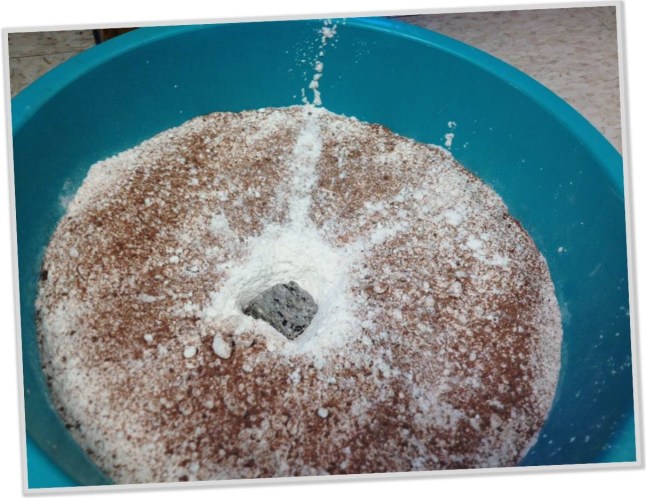
For the next three days of class, students will be designing, performing, and writing their own Craters Lab. The goal of their lab is to simulate the creation of impact craters on the lunar surface, and then to see whether those craters match what has been found on the surface of the moon.

Some groups are choosing to compare small asteroids to large asteroids, while some are simulating asteroids flying in at different speeds and/or angles. Everyone’s lab is different. But the basic framework is the same: prepare a basin of moon dust (flour), create a layer of darker soil (cocoa powder) on top, drop an asteroid, and observe the results. Final drafts of the their lab reports will be due at the beginning of class on Tuesday.

January 21-25 – Design Your Own Craters Lab (pg414)

Thank you for those of you who are continuing to check the website everyday! As a reward, I am offering a prize to the first three students who can find me during homeroom tomorrow, and can tell me how this weekend’s snowstorm could be impacted by the phase of the moon.

The Lunar Crater Debate

This slideshow requires JavaScript.

In the 1960s there was a debate about what had created the craters on the surface of the moon. Dr. Jack Green believed they were the results of the moon’s volcanic activity; Dr. Eugene Shoemaker believed they were formed by asteroid impacts (to read more about their debate, please click here).

This week, students will be designing a lab that allows them to solve this mystery once and for all. By recreating the formation of lunar  craters, photographing them, and taking measurements, they will hopefully be able to prove that the craters are from volcanic activity, asteroid impacts, or both.

Today, students were introduced to the debate and asked to identify the characteristics of both types of craters. Students then made hypotheses about which scientist they thought was correct. Tomorrow, we will begin designing our labs.

January 20 – The Lunar Crater Debate (pg413)

Thank you for those of you who check the website so regularly. For those of you reading this, I would like you to go outside tonight and observe the moon. If, during homeroom tomorrow, you can tell me what phase of the moon was visible, I will give you a prize!


Letters to the Past

LetterstothePast

Today we took a break to review what we have learned over the past two weeks. So far, we have covered gravity, the Sun-Earth-Moon relationship, moon phases, eclipses, and tides.

The assignment today was to revisit the nine astronomy myths we covered last week and to write a letter back to the authors of the myths. The letters explained today’s scientific explanation for whatever phenomena they were observing. For example, moon phases are not really the result of the moon god Annigan running circles around Earth and losing weight each week. They occur because of the moon’s orbit and because the Earth can’t always see all of the moon’s “bright side.”

At the end of the day, Mr. A will mail the letters back in time, which may cause a paradox that tears apart the fabric of the space-time continum. You have been warned.

January 15 – Letters to the Past (pg411)

This weekend’s HW is the Unit 4 Checkpoint Quiz. Click here to access the quiz. And remember to look over the answers you got wrong so you can figure out why!

Spring & Neap Tides

springandneaptides

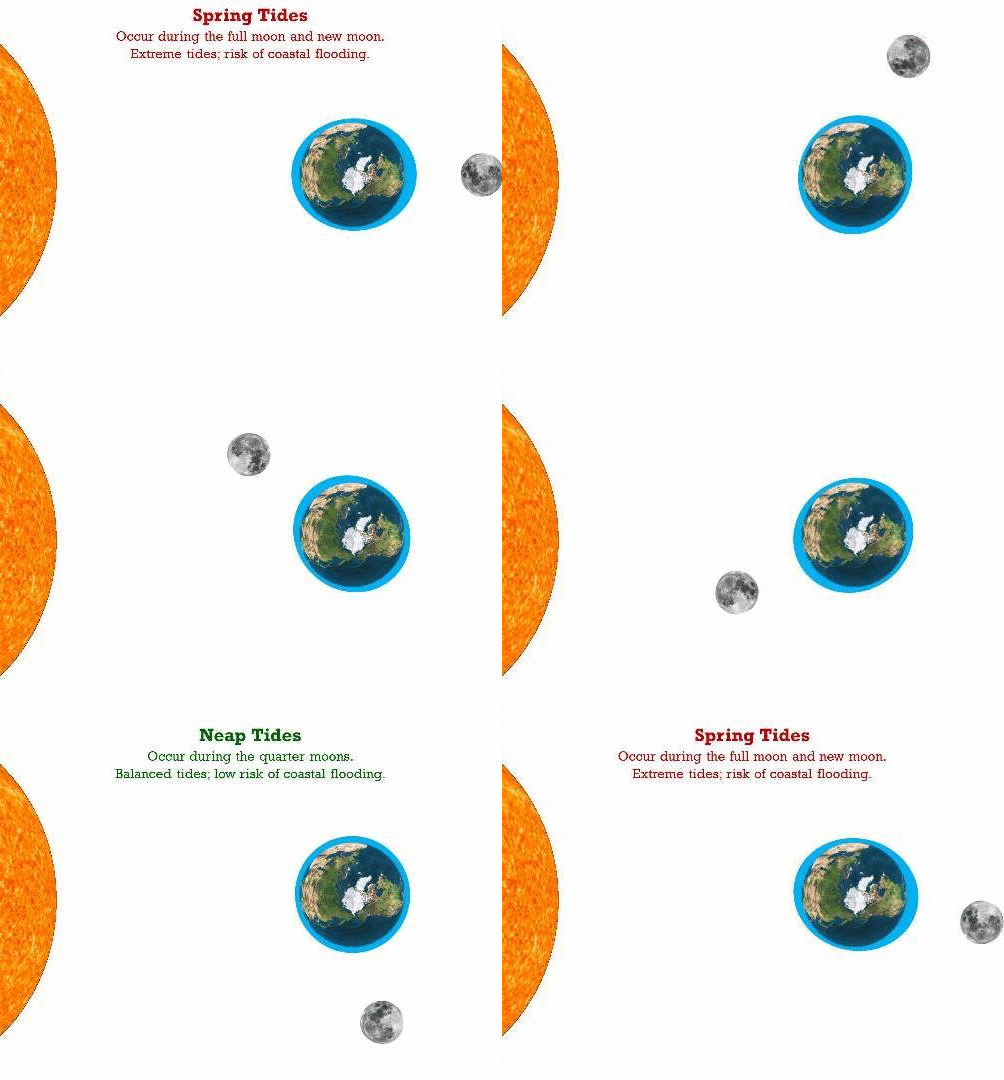
When a snowstorm is coming, people in Marshfield often discuss things like, “Is the storm going to hit at high tide?” or “Is it going to be a full moon?” or “Do you think we’ll have to worry about flooding?” But people rarely discuss exactly why a full moon causes these “flood tides.” And, in reality, it has nothing to do with the appearance of the moon and everything to with the Sun-Earth-Moon arrangement.

During a full moon or a new moon, the Sun, the Earth, and the Moon are basically positioned in a straight line. The moon’s gravity and the sun’s gravity are working together in parallel, and this produces extreme tides called spring tides. However, during a quarter moon, the sun’s gravity is working perpendicular to the moon’s gravity; the sun is literally subtracting water from the high tides on either side of Earth. This results in more balanced tides called neap tides.

So when if we ever have a snowstorm this winter, let’s hope it hits during a quarter moon. Otherwise, Brant Rock could be underwater!

January 14 – Spring and Neap Tides (pg410)

Eclipses

Error
This video doesn’t exist

We began today by reading a surprising story about how a lunar eclipses saved Christopher Columbus. To make a long story short, Columbus and his men were shipwrecked in Jamaica and used a lunar eclipse, supposedly created by their angry Christian god, to scare the natives into supplying he and and his men with food. But that story, odd as it is, begs the question… what really causes eclipses?

A lunar eclipse is caused by the moon orbiting directly through Earth’s shadow. On the night of a full moon, the moon will slowly disappear. It looks almost as if it is being erased from the sky, only to turn a dim red color (caused by the sunlight trickling through Earth’s atmosphere) and then becoming visible again about an hour later.

A solar eclipse, on the other hand, happens during the daytime when the moon passes directly in front of the sun. Sunlight is either partially or totally blocked, and onlookers are left with a darkened sky for about 5-10 minutes. This type of eclipse is much more rare because a person must live directly underneath the moon’s small shadow in order to see it!

January 13 – Eclipses Notes (pg408)
January 13 – Skywatch (pg409)

Moon Phases

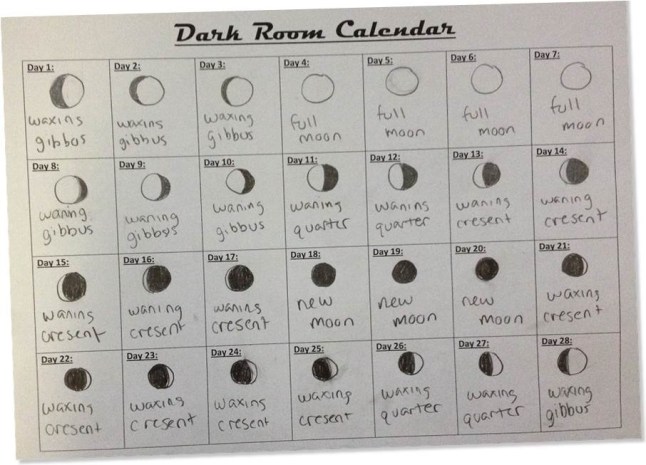
Today’s topic was “moon phases,” the vocabulary and geometry behind why the moon appears to change size each month. In reality, there is nothing changing about the moon; it is always the same size, orbiting roughly the same distance from Earth, receiving the same amount of sunlight. What we call “moon phases” is really a change in how we view the moon, not a change to the moon itself.

As you can see in the video above, when the moon is directly behind Earth, we are able to see all of it’s illuminated side. This called a full moon. After that, the moon enters the waning gibbous phase, shrinking each day as it goes. Then comes the waning quarter, followed by the waning crescent, and eventually a new moon. After that, the moon begins waxing, or growing, each night. It starts out as a waxing crescent, then a waxing quarter, eventually becomes a waxing gibbous, and then becomes a full moon again. This process is repeated roughly once per month.

DarkRoomCalendar

Thank you to those of you who visit the website religiously. As a reward for those of you reading this, I will give a prize to the first person who visits me during homeroom and whispers the password “eclipse.”

January 12 – Moon Phases (pg407)