Interstellar Travel

The moon is about 239,000 miles away. Neptune is about 2,700,000,000 miles away. And Alpha Centauri, the closest star other than our sun, is about 25,000,000,000,000 miles away. The problem is, at a certain point, large numbers like that tend to lose their meaning.

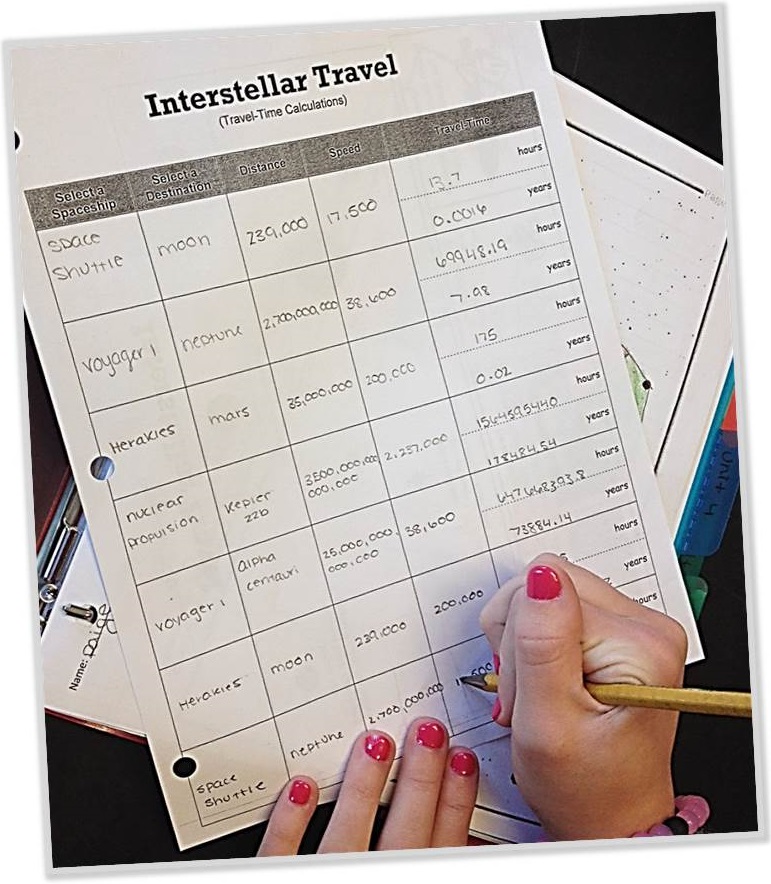
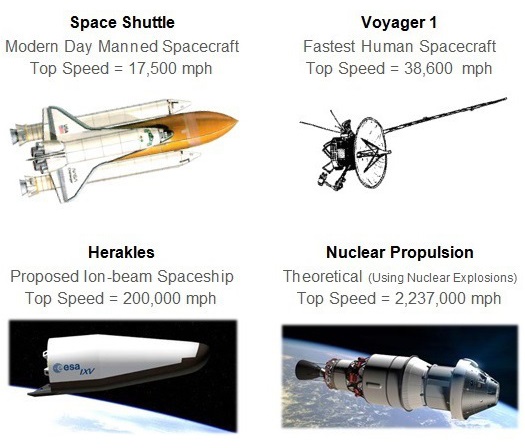
Understanding the vastness of space requires a different approach. Today, students leanred how to calculate travel-time, the amount of time it would take to reach each of these destinations. First, they had to choose their spacecraft.
spaceships1

By dividing distance by speed, students were able to estimate the amount of time it would take to reach each destination. For example, aboard the space shuttle, it would take only 13.7 hours to reach the moon, but it would take 17.6 years to reach Neptune! And even aboard Herakles, a proposed ion-beam spaceship, it would take almost 2 million years to reach the closest Earth-like planet (Kepler 22b). So the next time you are tempted to litter, remember, the most important Earth-like planet is right beneath your feet.

February 12 – Interstellar Travel (pg504)

The Life of a Star (Day 2)

loas

Today we were finally able to finish our study of The Life of a Star. Students created a foldable study guide that illustrated and described the life cycle of both small and large stars. All stars form from stellar clouds, made of mostly hydrogen. They emit heat and light through the process of fusion. The small ones end up as white dwarfs, the medium-sized ones become neutron stars, and the largest become black holes. The child stars rarely amount to anything…

Make Your Own Constellation

myoc

Today we got back on track by introducing the topic of constellations. For thousands of years, humans have observed patterns in the stars above and have come up with explanations for what they were seeing. For example, the Yakima Tribe believed that the “Cassiopeia” constellation was really the skin of an elk, killed by a hunter and then hung out to dry in the heavens above.

But constellations, as we now know, are not some mythical thing. They are simply distant suns, not all that different from our own sun. They are just so darn far away that they appear to be small and unmoving.

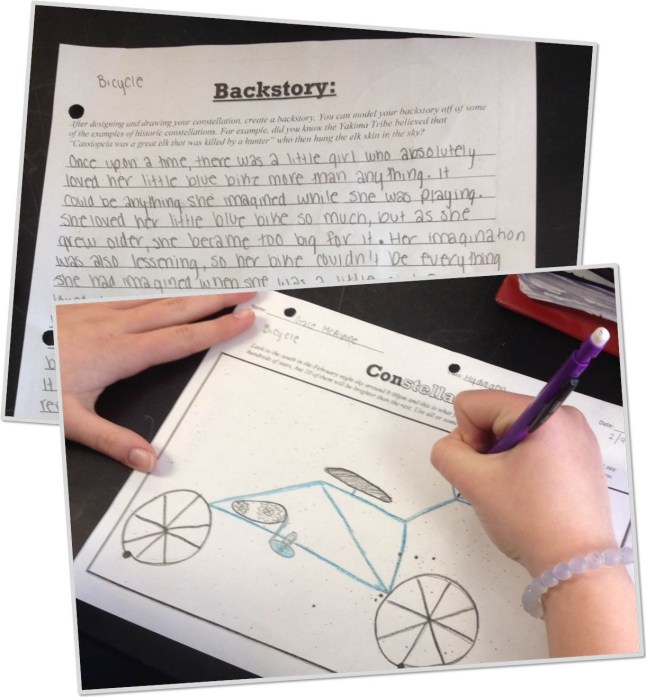
Today in class, students analyzed a photo of the February night sky and made up their own constellations, complete with an illustration and a backstory. For a great example, check out Grace McAlpine’s work in the photo above!

February 9 – Make Your Own Constellation (pg503)


The Life of a Star

thelifeofastar

Today was an early-day, so we only had a 20-minute class period. We used it to introduce The Life of a Star. Just like us, stars have a story of life and death. They are formed from stellar clouds and are basically large clumps of matter (mostly hydrogen) that are pulled together because of gravity. When those clumps get large enough, the immense pressure and temperature create nuclear fusion. Hydrogen atoms combine to form helium, and in doing so they produce light. As stars go through their life cycle, small stars eventually become white dwarfs, medium-sized stars eventually become neutron stars, and the largest stars are thought to form black holes. But don’t worry, Sophie. Our sun is a small star, not nearly large enough to become a black hole!

February 4 – The Life of a Star (pg502)

Objects in Space

This slideshow requires JavaScript.

Today, we began Unit 5: Our Solar System & Beyond, which is one of my favorite units of the year. Finally, we get to stop worry about moon phases and tides and start worrying about the really worrisome stuff: black holes, supernovae, aliens, asteroids, etc.

We began the unit with a lesson called “Objects in Space.” Although there are gazillions of different objects up there — some we see everyday and many we haven’t even discovered yet! — most of them can be sorted into seven basic categories: asteroids, planets, moons, stars, galaxies, stellar clouds, and black holes. Today we defined each other the seven types, discussed them, and then students drew an illustration of outer space that had to include all seven types of objects.

February 3 – Objects in Space (pg501)

Unit 4 Test

Good luck on the test today, everyone. Remember your waxing and waning, your spring tides and neap, why daylight is fading, before we all sleep. Remember your asteroids, and those craters rays, your lunar eclipses, and of course L.i.L. Wayne. But most of all, remember that I’m not good at poetry and rhyming is hard.   – Mr. A