The Evolution of Dragons

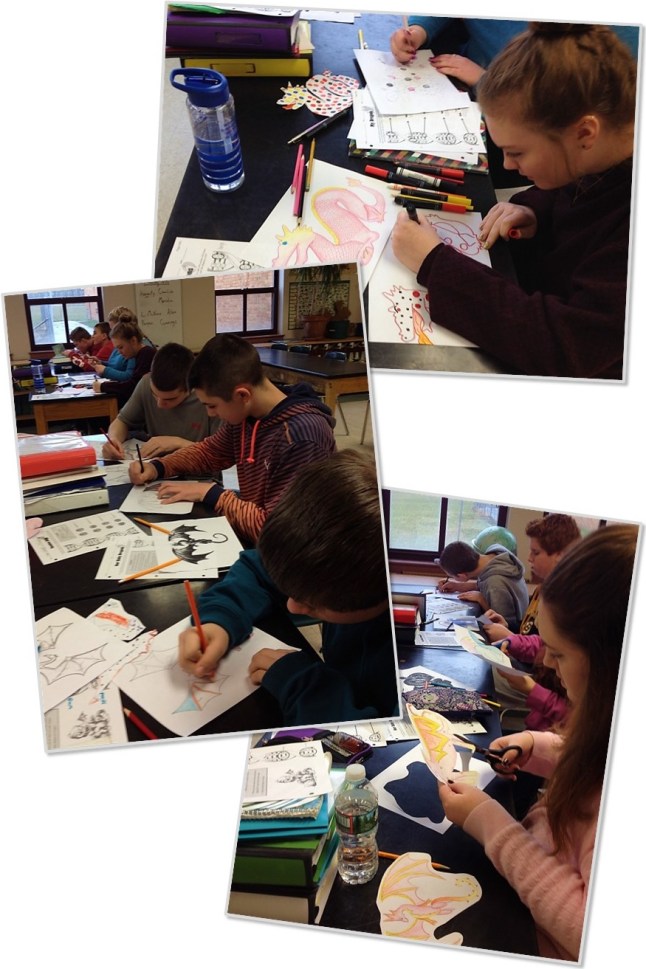
What would happen if you took a group of dragons and moved them to a new environment? What if the new environment was a small, cramped, barren island? Would the dragons evolve? Would the species become smaller? Would they eventually become more aggressive? All was answered in today’s activity.
EoD

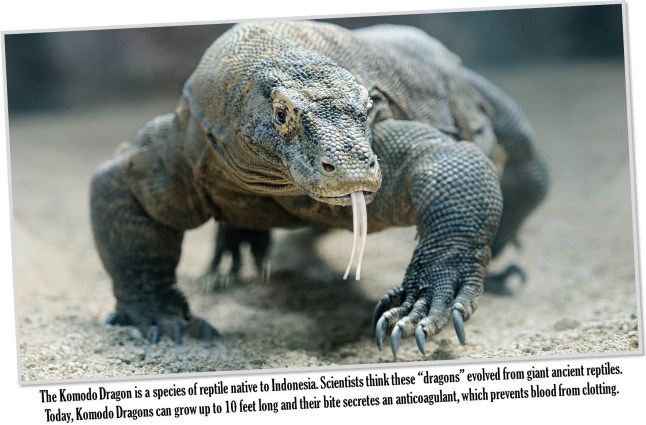
As it turns out, an environment with less food actually favors smaller animals. The larger animals would slowly die off, while the small ones would be more likely to reproduce. The color of the dragons could change as well. Over time, the bright dragons could be more likely to be hunted by humans, so the species could evolve camouflage. They would most likely become friendlier too, not to outsiders, but to each other. Species that have evolved to live in close quarters, like bees, are typically very cooperative. The dragons would also probably have to fly offshore to hunt; this would lead to the extinction of the wingless varieties of dragons. Lastly, the dragons might evolve to have regular tails. The spiked and clubbed tails take a lot of energy to carry around, and probably would not be worth it as the species grew smaller.

So there you have it. After a few million years, rather than an island full of dragons, you might find a species of small lizards. How very, very uncool 😦

April 1 – The Evolution of Dragons (pg610)

This weekend’s HW assignment is to complete the Unit 6
Checkpoint Quiz. To access the quiz, please click here.


Catch-Up Day

Finally, the interruptions for this week are over. We are done with our three days of MCAS testing. By now, all classes should have completed the following three lessons.

1. Darwin’s Theory

2. Stick Bug Simulation

3. Evolutionary Trade-Offs

If your were absent, or missed class for any reason, make sure you go over the three lessons listed above. Tomorrow (Friday), we will take part in one of my favorite lessons of the year: The Evolution of Dragons.

Evolutionary Trade-Offs

Color, size, personality: these are different characteristics that organisms have. But believe it or not, no trait is good or bad. It’s our environment that makes them so!

Today the students predicted how our dragons might evolve when subjected to a change in environment. On Friday, we will be moving the entire species to The Isle of Doom and then observing the result. The Isle of Doom is a small island off the coast of Greenland. It is a small, barren environment that our dragons fled to in order to escape the attacking humans. But there’s not much food there, or space to live. And the dragons routinely battle with attacking Vikings and cold, harsh weather… not to mention each other!

In order to predict how the dragons might evolve in such a hostile environment, we learned about how some real-life animals have evolved in similar circumstances.

Slide1Slide2Slide3Slide4Slide5

By reading five different articles (click the images above), students were able to find similarities that allowed them to predict the evolutionary path of our dragons. On Friday, we will get to see whether our predictions came true. Will the dragons evolve to be friendly or mean? Will it pay to have a spiked tail? Will brightly colored dragons have a mating advantage? We shall see.

March 30 – Evolutionary Trade-Offs in Dragons (pg609)

Stick Bug Simulation

Because of MCAS, this week is an interrupted week. That means that I will not see every class every single day. For those classes who I have seen, you should have completed the Stick Bug Simulation. It is a computer game where students have to hunt for stick bugs (by clicking on them), and then track how the population evolves.

The full assignment is posted below. It is due Friday, April 1st.

March 29 – Stick Bug Simulation HW (pg608)

Darwin’s Theory

charlesdarwinsmall

Charles Darwin left home at age 22 aboard the ship The HMS Beagle. When he got back, he had made a discovery that would change the path of modern science. He just didn’t know it yet.

On his journey sailing around the world, Darwin was amazed by the natural diversity he observed. The Galapagos Islands, in particular, had a fantastic range of species. Even the little finches seemed to be different on almost every island. Years later, Darwin wrote about the finches: “Seeing this diversity in one small group of birds, one might think that from an original group of birds on these islands, one species had been taken and modified for different ends.”

Years later, this observation led Darwin to publish his theory of natural selection. The theory, now accepted by 99.9% of scientists, states that when species have variety, they reproduce at different rates. For example, one finch might be born with a thinner beak, allowing her to eat worms more easily. Because of this advantage, she would be able to obtain more food, she would be healthier, and she would be better able to care for her young. Over time, the genetics for that thin beak could be passed down and spread throughout the entire finch population.

Of course, this would not happen overnight. Evolution like that could take thousands of years. But any time there is (a) a competing population, (b) genetic variation, and (c) inherited traits, evolution will indeed happen. And over millions of years, you could turn a fish into a rodent, a rodent into an ape, and an ape into a human!

March 28 – Darwin’s Theory (pg607)

Hawks & Field Mice

hawksandfieldmicegraph

Today we took a break from our DNA lessons to play a game called Hawks & Field Mice. The goal of the lesson was to explore the role that camouflage plays in the predator/prey relationship. The students played the role of the predator (the hawks), while the prey were little tiny paper mice scattered across the ground.

As the game went on, something interesting happened. The black mice were able to blend in with the dark ground on the auditorium stage. The yellow and green mice were found more quickly and more often. After a few rounds, the majority of the surviving mice were black. And just like in real life, when mice reproduction was simulated, most of the mouse babies were also black.

Over time, the population of mice developed camouflage. And they did so naturally. Our paper mice were not aware that they were developing camouflage, nor were our human predators. And yet, by the end of the game, the population seemed to fit its environment almost perfectly. How interesting!

March 24 – Hawks & Field Mice Lab (pg606)

Our Baby Dragons

ourbabydragons

After finishing our dragons yesterday, today we chose partners to mate with. (I don’t mean literally. No worries, parents.) To simulate our dragons combining DNA, we simply flipped a coin for each line of the genetic code. If we flipped heads, we passed on the father’s first line of code (ex. CG). If we flipped tails, we passed on the mother’s first line of code (ex. TA). After repeating this process for the entire DNA strand, we saw some interesting results. Just like in real life, most baby dragons looked like their parents. But sometimes there were strange combinations of genes. In one class, we even had two light-colored parents give birth to a polka-dotted child!

March 23 – Our Baby Dragons (pg605)