Martian Lander Project – Day 4

—  Day 1  —  Day 2  —  Day 3  —  Day 4  —  Day 5  —

MLPD4

Summary:
Today, we started off with a brief discussion of the science behind yesterday’s egg drop. We mentioned all three of Newton’s Laws, but in particular, we focused on his second law: f=ma. We discussed how, in order to minimize the amount of force that our eggs experienced, there were only two possible strategies. The first was to reduce the mass; but there was a limit to how light our landers could be, given that they had to include a 55 gram egg. The second strategy was to reduce the acceleration. Slowing down the egg slowly, and at a low cost, was the key to winning the Martian Lander Project.

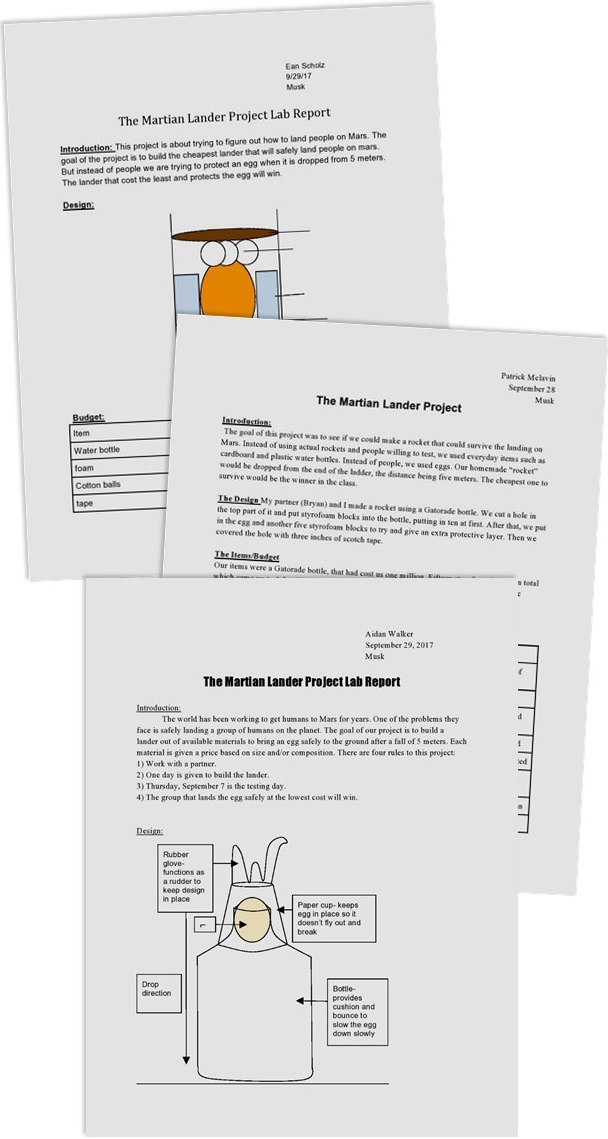
After this discussion, students began typing the final drafts of their lab reports. They followed the same format as the rough draft (posted below), so their reports must include the same five sections: introduction, design, budget, results, and conclusions. They will finish their reports tomorrow.

Resources:
September 27-29 – Martian Lander Report (pg118).docx
Martian Lander Project – Day 3

—  Day 1  —  Day 2  —  Day 3  —  Day 4  —  Day 5  —


Summary:

Today was the third day of the Martian Lander Project. The fun day. Testing day! Each class traveled down to the auditorium, egg in hand, and tested their landers from a height of about 5 meters. Results were… messy.

Students used the data tables in their lab report (posted below) to keep track of each group’s results. This included the cost, the fall time (recorded with a stopwatch), the end result (broken or safe), and their observations. A fun day was had by all. Except a few of the astronauts.

Resources:
September 27-29 – Martian Lander Report (pg118).docx

Martian Lander Project – Day 2

—  Day 1Day 2Day 3Day 4Day 5

MLD2

Summary:
Today was the second day of the Martian Lander Project. Students spent the first portion of class building their Martian Landers. But it came with a twist. Every material had a price. For example, mattress foam cost a steep $4 million, while a cereal box cost only $1 million. So students had to design a functional lander while also keeping the cost down. The group that wins will be the group whose egg survives, but whose lander has the lowest possible cost.

After working anxiously for most of the period, students began the rough draft of their lab report (posted below). They filled in the introduction, sketched their design, and kept track of their budget. The remaining parts of the report will be filled out later.

Resources:
September 27-29 – Martian Lander Report (pg118).docx
Martian Lander Project – Day 1

—  Day 1  —  Day 2  —  Day 3  —  Day 4  —  Day 5  —

MLP1

Summary:
Today we began our “Martian Lander Project,” which is a modern take on the age-old egg drop experiment. The goal of the project is for students to design a spaceship that can land an egg safely after a drop of 5 meters. This is equivalent to a drop of 13 meters on Mars. We imagined each egg as a capsule containing a team of astronauts that must land safely on the Martian surface. And of course, the goal of our experiment is the same as its real-life equivalent: minimize the force of impact.

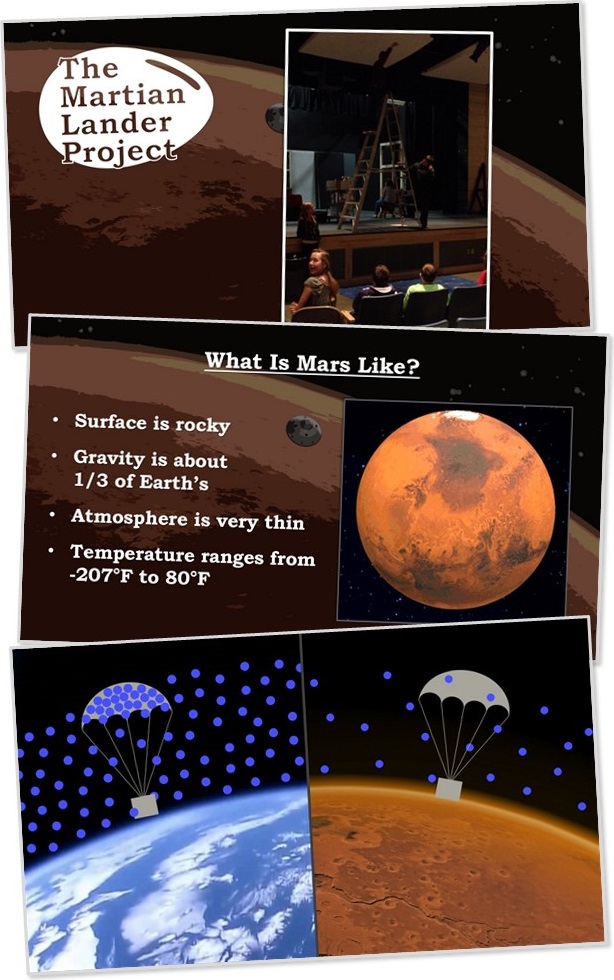
But there’s a twist. The winning team will be the group who accomplishes the goal (protect the egg!) at the lowest possible costs (each material will have a set price). Students were introduced to the project today and went through the PowerPoint below. Tomorrow they will build their Martian Landers. The following day we will test them. And the last two days of the project we will work on our lab reports.

Resources:
September 26 – Intro to The Martian Lander Project (pg117).pptx

Review Carousel


Summary:
Today we took a much-needed pause from advancing the curriculum. Students completed what I call a “Review Carousel.” Groups of students rotate from table to table, and at each table there is a different topic and question. Every 5 minutes, a bell rings and students move to the next table, where they will find the next question as well as the answer to the previous question. It was a good day to strengthen what we have learned so far in Unit 1.

Resources:
September 25 – Review Carousel Table Questions.docx
September 25 – Review Carousel Timer.pptx
September 25 – Review Carousel (pg116).docx

Very Vexing Vectors

Vectors

Summary:
Today was difficult. One of those Fridays that makes you question the pace of your teaching. Students completed the Very Vexing Vectors packet, with a lot of help from me. It included four different examples with questions to go along with them. It was clear from today that (a) vectors are a difficult concept for 8th graders, (b) we need more practice with vectors, and (c) I need a nap.

Resources:
September 22 – Very Vexing Vectors (pg115).docx