Forces of Nature – Day 3

 — Day 1Day 2 — Day 3 — Day 4

.
Summary:

The second challenge in our Forces of Nature project was different. Instead of dealing with a disaster-in-progress like yesterday, today was about planning and preparedness. The email students received started off like this: “Dear FEMA, my name is Amy Keller, I work in the White House Expense Office. The latest senate session has decided to issue a $500 million grant for ‘Earthquake Planning and Preparedness.’ I am contacting you to ask for advice on how to best spend the money.”

Students worked in teams of two and attempted to determine which cities deserved a portion of the money. By using the maps posted below, students determined that San Francisco, Los Angeles, and San Diego should receive the majority of the funds. Then they got to work making recommendations on how the money should be spent. Should they strengthen roadways and bridges? Is it worth it to reinforce skyscrapers? Which is better, a sea-wall or tsunami detection buoys? In their emails, students provided $500 million worth of answers.

Resources:
April 13 – Letter, Maps, etc.zip
Forces of Nature – Day 2

Day 1 — Day 2 — Day 3Day 4

.
Summary:

Today was the second day of the Forces of Nature project, and our first real disaster. Students walked into the classroom to find their desks set up like a real FEMA office. And at each desk was an email. “Dear FEMA employees, my name is Patrick Connors, head of the California State Fire Department. We’ve had an outbreak of severe fires recently outside of Los Angeles, in Bishop CA, and outside of Sacramento. Local fire crews and town fire departments are overrun. We need your immediate assistance…”

Their task today was to help plan the defense of California against three separate wildfires. Students had to consider the population distribution in California, the state’s climate, today’s weather and wind direction, etc. By replying directly to the email, students were able to advise the state on how to deploy their firefighting forces. They had access to 12 fire trucks, 2 fire-line crews, 2 helicopters, and 1 airplane. And their task was to deploy all of these forces in the most intelligent way possible. Which fire will spread the fastest? Which fire will affect the most people? Where she we dig our fire-lines? These were not questions with easy answers. For a copy of all of the project materials, please click the links below.

Resources:
April 12 – Letter, Maps, etc.zip

Forces of Nature – Day 1

— Day 1 — Day 2Day 3Day 4

This slideshow requires JavaScript.

Summary:
We began our Unit 6 capstone project today, a project called “Forces of Nature.” The premise is that the students work for FEMA and are charged with managing natural disasters of varying types. Specifically the project will focus on wild fires, earthquakes, and flooding. Each day of the project, students will walk into the room to find a new disaster that they must manage. By consulting maps, diagrams, videos and other resources, students must come up with a solution and then consult with forces on the ground (via email) to instruct them on how to best manage things. Today was simply the project introduction. We briefly reviewed what we have studied so far in Unit 6, learned about FEMA, and divided students into teams (see the PowerPoint below for more information). Tomorrow we will begin the project for real.

Resources:
April 11 – Intro to Forces of Nature (pg617).pptx

Graphing Seasons & Climate – Day 2

.
Summary:
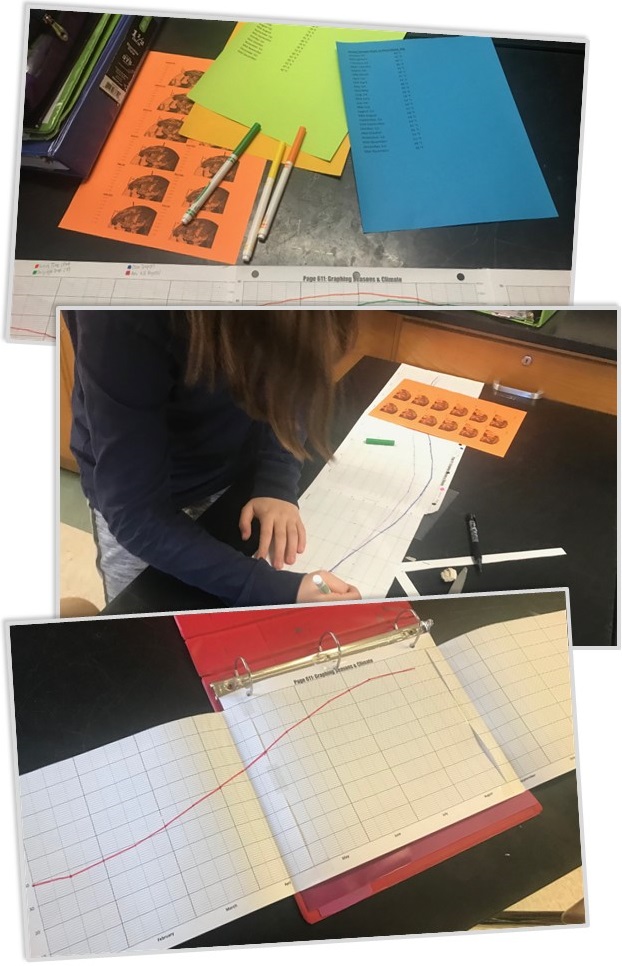
Today was the second day of our graphing project. Students finished graphing the daily high temperature, the ocean temperature, sunset time, and Earth’s tilt. When finished, the relationship was clear. Sunset time, air temperature, and ocean temperature are all related (with some time delay). And Earth’s tilt has a negative correlation with sunlight and temperature. Those students who finished early set to work graphing arctic sea-ice levels and atmospheric CO2 levels for extra credit. News flash, they’re related!

Resources:
April 9-10 – Graphing Seasons and Climate (pg616).docx
Graph Data – Temperature, Tilt, etc.zip

Graphing Seasons & Climate – Day 1

GS&C

Summary:
Today students began a project where they will be asked to graph Earth’s season’s and climate… all on one piece of paper! It’s no easy task. They began by taping together a giant three-page line graph that stretches from January all the way to December. Upon that page they will be asked to graph four things: the daily high temperature, the ocean temperature, the time of sunset, and Earth’s tilt. All data was specifically tailored to fit their hometown of Marshfield, Massachusetts. By using a separate axis on the left side (°F), and using a different axis on the right side (time of day), and by squeezing Earth’s tilt to fit that first axis, all three data sets can be overlaid onto the same graph. Most students were about halfway finished by the end of one class period. For more details, see the attachments below.

Resources:
April 9-10 – Graphing Seasons and Climate (pg616).docx
Graph Data – Temperature, Tilt, etc.zip

Weather vs. Climate

WvC

Summary:
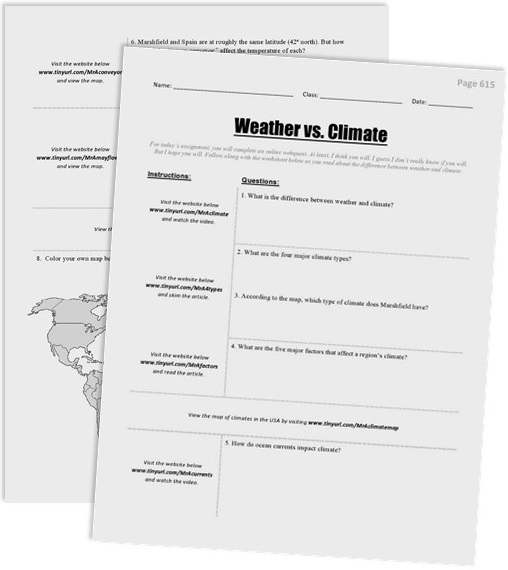
Weather and climate are two different things. And it’s an important difference. While weather includes the day-to-day fluctuations in temperature, wind, clouds, and precipitation, climate is more like the long-term average. For example, we all know that the average weather in Marshfield, Massachusetts is quite different from that of the Sahara desert. Today, students completed a WebQuest that helped them investigate weather vs. climate. It covered the different types of climate, mapped climate patterns across the Earth, and even explained why so many Pilgrims died during their first winter in the new world. For a copy of the assignment, click the link below.

Resources:
April 8 – Weather vs. Climate Webquest (pg615).docx

Playing with Fire

.
Summary:

Wild fires are one of the topics we will be highlighting in Unit 6. And the key to fighting a wild fire is understanding it. Fire, in general, is simply a chemical reaction that releases heat. As molecules break apart, they bump into other molecules which then break apart. The characteristic flame appearance is simply hot air, rising to the temperature at which air glows (977°F), and then floating away and cooling off. In order to support most fires – and to keep the chain reaction going! – you need a fuel source (molecules to break down), a supply of oxygen (to support the chemical reaction), and a net gain in heat (breaking molecules must produce more energy than they require). We investigated all three of these factors in today’s lab. For more details, see the video above.

Resources:
April 7 – Playing with Fire Lab (pg613).docx
April 7 – Playing with Fire Post-Lab (pg614).docx