day4

Today we finally got to observe what has been growing in the boiler room for the past three days. Needless to say, it wasn’t pretty. But it sure was educational.

By comparing the germ growth of different agar plates that had been covered with different plants and spices, students were able to determine each plant’s germ-killing effect. Cinnamon killed the most germs by far, followed by nutmeg, and mint. The five other plants (pine bark, oak bark, leaves, grass, and pine needles) did not have any germ-killing effects. So what does it all mean? That is the topic for tomorrow’s lesson.

April 12 – Of Spice and Men (pg614)


The Seven Skulls

We are taking a break from Of Spice and Men today, in order to let our germs grow for an extra day. We will continue the project tomorrow.

The final evolution topic we’ll be covering is perhaps the most famous and most relevant topic in Unit 6, and that is the evolution of humans. Today in class, students examined replicas of seven different skulls that were in some way related to the human skull. They examined the size, the thickness, the bone structure, and even finer details like the eyebrow ridges and the lines. After examining all of the skulls, students made a hypothesis about the order in which the skulls had evolved.

But all of the hypotheses were wrong. And I mean way wrong. I mean the not-even-close, better-luck-next-time kind of wrong. And that’s because our students assumed, like most people tend to assume, that evolution happens in a straight line… nice and organized… one species at a time. But it doesn’t.

thesevenskulls

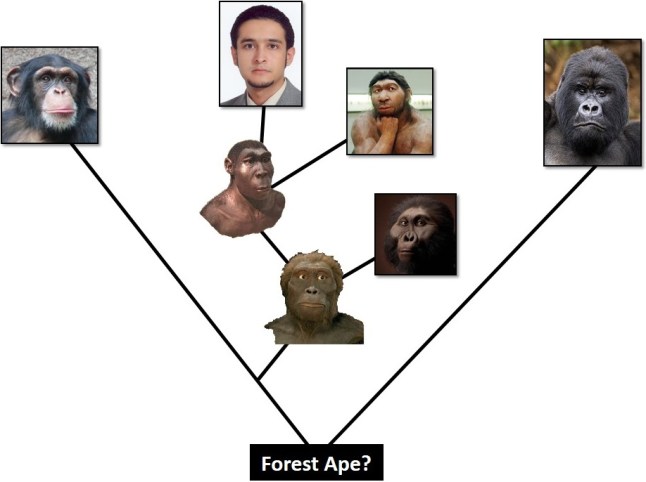
Real evolution more closely resembles a tree. Over time, the species grow and change, sometimes quickly, sometimes slowly. At some point, most of the branches reach a dead end and die. After all, no species will stay on this Earth forever. It takes just the right environment, and a little bit of luck, to allow a species to evolve from some ancient forest ape, into a bipedal organism with two free hands, into the primitive tool-using homo erectus, into a human.

April 11 – The Seven Skulls Lab (pg615)

Your homework tonight is to watch a YouTube video about evidence of
evolution that can still be found on our bodies. Click here to access the video. 

day3

Today was the third day of our capstone project, and we’re now one step closer to answering the question “Why do humans like what we like?” Today, students took their finished agar plates from the fridge and added germs from their saliva to each one. After that, it was time to add the spices. Most groups chose to cover half of each Petri dish, so they could compare germ growth in the empty half of the dish to germ growth in the spice-covered half of the dish, thus building their control group right into each test. The students could then use their separate dishes to compare mint leaves to regular leaves, cinnamon bark to pine bark, or any other combinations they could think of. Tonight, Mr. A will store the dishes in a warm, dark location. We will then let the germs grow for three full days. On Tuesday, we will observe our results.

April 8 – Of Spice and Men (pg614)

day2

Today was the second day of our capstone project, and it was really more about prep work than anything else. Students started off by making a hypothesis about which plants/spices might have germ-killing effects. Then, they set about making agar plates, which are gel-filled Petri dishes on which you can grow microorganisms. In other words, they are like “Germ-Food Jello.” The agar plates are being refrigerated overnight. Tomorrow, the students will add germs and spices to the dishes. And after we let them grow over the weekend, we should finally be able to solve this mystery, once and for all!

April 7 – Of Spice and Men (pg614)

day1 Today we began our Unit 6 Capstone project, called Of Spice and Men. The goal of the project is to measure the human preference for the tastes of different plants and compare it to each plant’s germ-killing effects.

mintvspine1

The essential question behind the experiment is one that baffled scientists for centuries. Why do we enjoy the tastes of mint, cinnamon, and other herbs & spices, when they offer little nutritional benefit? It wasn’t until fairly recently, after scientists began experimenting with germs, microscopes, agar plates and the like, that this question was answered. In fact, those same tools have helped unravel mysteries about nutrition, helped cure polio, and even helped Fleming discover penicillin.

agarplates

This week, students will be growing germs on agar plates and testing how different plants affect the germs’ growth. With the above tools, we should be able unravel the mystery behind spices. But first, we needed to measure the “human preference” for these plants. We did this using a simple classroom survey at the end of class, where students smelled eight different spices and rated how they thought each one would taste, on a scale from 1 to 5. No surprise here; cinnamon had the highest rating.

April 6 – Of Spice and Men Notes (pg 613)

The Evolution of Bacteria Lab

drugresistantbacteria

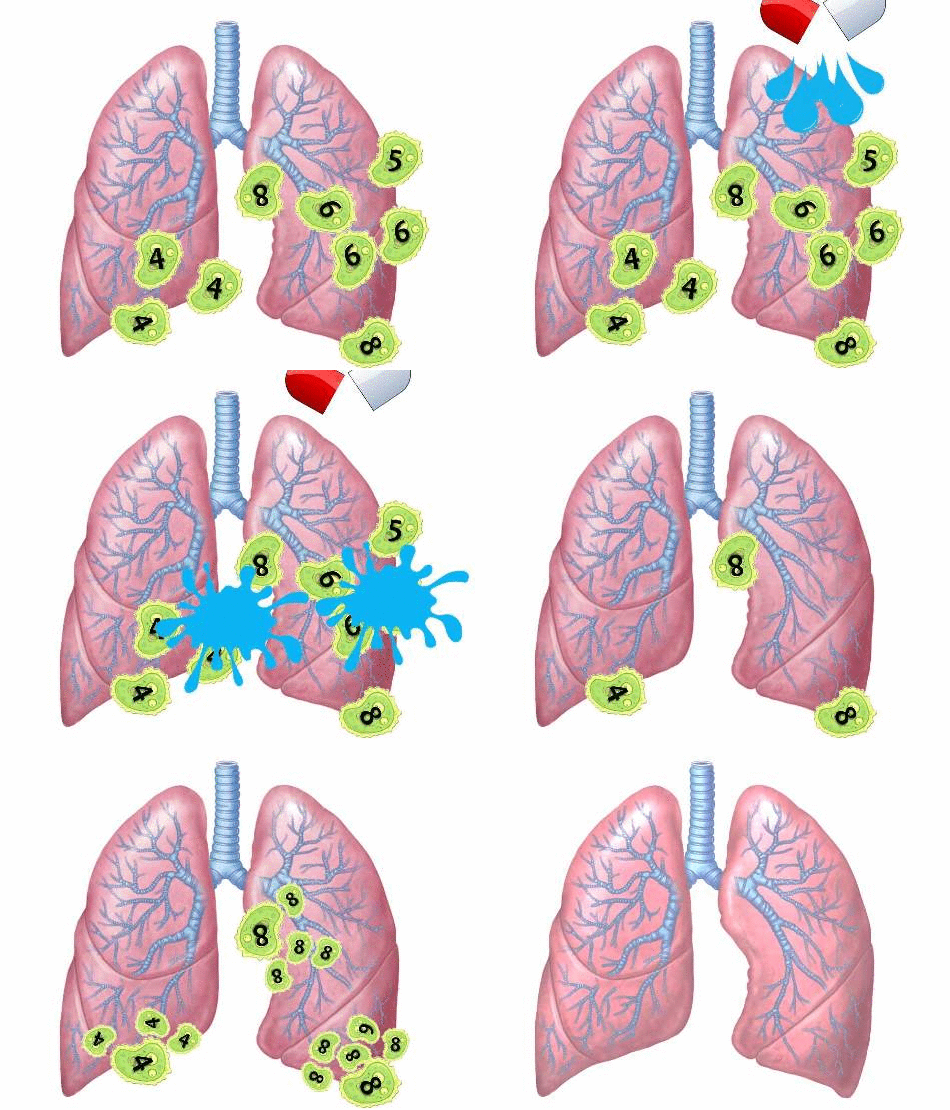
When you have strep throat, or pneumonia, or some other bacterial infection, doctors usually prescribe an antibiotic. But what happens when you don’t finish the prescription? Or what happens if you pass off your germs before your body finishes killing the infection? The answer is evolution.

Today in class, students simulated how strep throat could be passed from student to student and how it could be treated with penicillin. We used dice to play the roll of the penicillin, and we used numbers on each bacterium to represent the cell’s strength. If you rolled a number higher than the strength of the bacteria, the penicillin was able to kill it.

However, just like in real life, this left us with a problem. The surviving bacteria were usually the strongest ones. And if they were passed on to a new person where they were able to reproduce, that person would have an even stronger version of the infection! By the end of the game, our strep throat bacteria were notably stronger. Of course, in real life, this type of evolution takes years. And new antibiotics are being developed all the time. But that won’t last forever… who knew evolution could be so cruel?

April 5 – Evolution of Bacteria Lab (pg 612)

3modEoEv

One common misconception about evolution is that, “It’s just a theory. Scientists have never been able to observe it happening.” This statement could not be more wrong. In class today, we learned about three modern examples of evolution that have occurred within the course of human history.

The first example was the peppered moth. During the industrial revolution, pollution changed the landscapes in urban England. The white trees that the moths lived on were suddenly covered in black soot. In response, the peppered moths began exhibiting a recessive trait; instead of being white with black flecks, the moths changed to be fully black. This was one of the first examples of evolution observed after Darwin’s theory was published. Ironically, when England began to curb its pollution problems, the moths evolved into their original color!

The second example was one that involved humans themselves: the evolution of human skin. Since the human species left Africa about 200,000 years ago, our skin tone has been evolving. One of the important trade-offs regarding skin tone deals with sunburn protection vs. our ability to capture vitamin-D. A human with dark skin will have a harder time capturing vitamin-D, but will be less likely to become sunburned. And someone with lighter skin will have the opposite problem. As a result, those humans in northern climates (Ireland, Norway, etc.) evolved to have pale skin, while those in sunnier climates (Africa, Spain, India, etc.) evolved to have darker skin.

The last example was certainly the scariest: drug-resistant bacteria. When Alexander Fleming discovered penicillin in 1923, he changed the world. Suddenly, diseases like tuberculosis and pneumonia were entirely curable. And as a result, human life expectancy rose. But there was another result too. Because penicillin is most effective at killing the weakest bacteria, the stronger bacteria were often the lone survivors left to reproduce. Over the past hundred years, the germs have been evolving, getting stronger and stronger each time they are exposed to penicillin or other antibiotics. “It used to be that physicians could select almost any antibiotic to treat a patient,” says Richard Glew, M.D. “But that Golden Age of antibiotic use is over. The germs are winning.”

April 4 – Modern Examples of Evolution (pg 611)

Your HW tonight is to play the Peppered Moth Game (click here to access).
Be sure to read the three pages of instructions and to finish by playing the
computer game at the end (called “A Bird’s Eye View of Natural Selection”)