Vectors


Summary:

Today in class we introduced the concept of vectors. A vector, of course, is a quantity that has both magnitude and direction. But more importantly, vectors are an easy way to think about and solve problems that deal with multiple forces. We went through a PowerPoint (posted below) to introduce the concept, worked through an example problem together, and then let students practice on their own.

Resources:
September 21 – Vectors Notes.pptx
September 21 – Blank Vectors Notes (pg114).docx
Marble Collisions Lab


Summary:

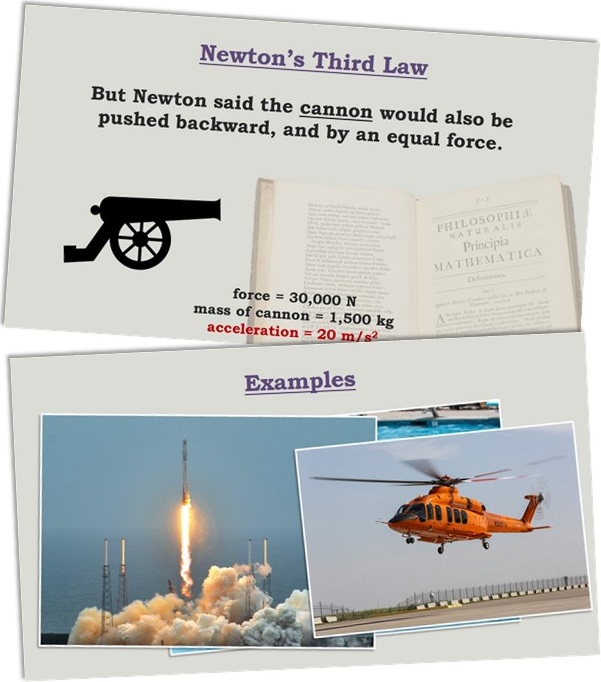
Today, students completed a lab that helped investigate Newton’s 3rd Law of Motion. It is based on the “Newton’s Cradle” toy, and it involves colliding marbles (see video above). Of course, for every action within the lab, there is an equal and opposite reaction. One marble rolled in, one marble rolled out. One marble slowed down, one marble sped up. And thus, we proved that Newton’s 3rd Law is indeed true.

Resources:
September 20 – Marble Collisions (pg113).docx
September 20 – Marble Collisions Answer Key.pdf

Car-Pushing Lab


Summary:

Today, students took part in the infamous Car-Pushing Lab. They took turns pushing my car across a 20 meter track. Using a stopwatch, they timed each pusher. Then they calculated acceleration using the a=2d/t2 formula, plugged in the mass of my car (1,350 kg), and calculated the force of each pusher.

The lessons included how to use Newton’s 2nd Law, that increasing the number of pushers will increase the force, and that increasing the mass of the car (everybody jump in!) will reduce the acceleration.

Resources:
September 18 – Car Pushing Lab (pg111).docx

Newton’s 2nd Law

Newtons2ndLaw

Summary:
Today, we went through a PowerPoint introducing Newton’s 2nd Law. I find that “f=ma” is the simplest description, and I try to simply explain that force depends upon two things: mass and acceleration. We then went through a few examples of how scientists could use that formula to make important predictions regarding everything from launching a rocket to kicking a football.

Resources:
September 13 – Newton’s Second Law (pg109).pptx

Friction Lab


Summary:
Today students completed the friction lab, a little experiment that explores how friction affects a rolling marble. The lab asks students to compare four surfaces (a table top, printer paper, wax paper, and sandpaper) and compare the amount of friction created by each. Students calculate the average distance that the marble rolls. And they repeat the experiment with a metal and plastic marble to investigate how the mass of an object can change the amount of friction.

Resources:
September 12 – Friction Lab (pg108).docx

Newton’s 1st Law

.
Summary:

Today, we began our study of Newton’s Laws, beginning with his first law. We defined it as “An object in motion stays in motion unless acted upon by an outside force.” We then went through a PowerPoint (posted below) that discussed some of the intricacies within the law as well as provided several examples. I also like to mix in several demos (see video above) including: the quarter snatch, the penny on the playing card, the flying yo-yo,  the beaker and the paper, and the egg tower.

Resources:
September 11 – Newton’s First Law (pg 107).pptx