… and the Environment

andthe Env

Summary:
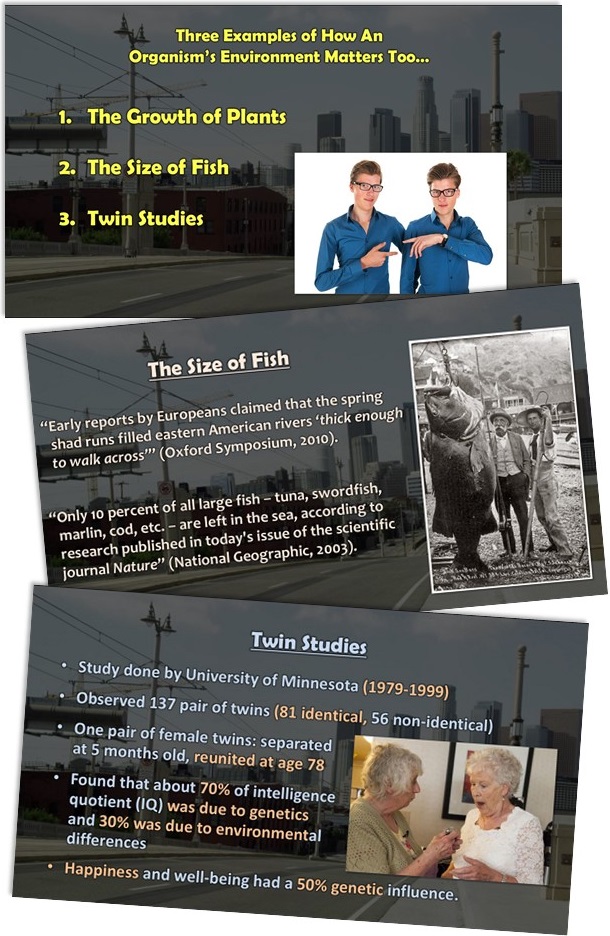
Today we introduced the last topic in Unit 3. I like to call it “… and the Environment.” The theme of the lesson was that yes, genetics matter, but the environment matters too! To illustrate this point, I used a PowerPoint that describes three examples. First, we discussed how the size of plants is determined by genetics and factors like sunlight, water, and soil quality. Second, we learned about how the size of fish is dictated by genetics and factors like overfishing, food supply, and the size of the lake. Third, we talked about twin studies. The studies show that, yes, there are lots of similarities between identical twins, but there are differences too. We ended class by playing a classification game.  Students pulled a topic out of a box and had to classify it as genetic, environmental, or both (using a Venn diagram). Both the PowerPoint and the classification game are posted below.

Resources:
December 8 – …and the Environment (pg315).pptx
December 8 – Classification Game.docx
The Genetics of Taste Lab

.
Summary:

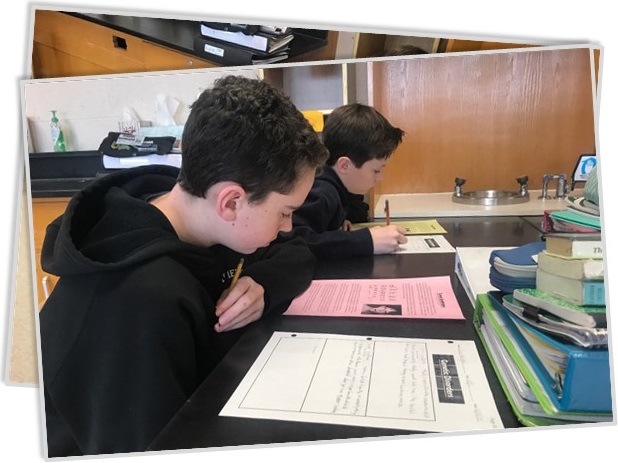
Today we did a lab called “The Genetics of Taste.” Students did a taste test that included four different compounds: sodium benzoate, thiourea, phenylthiocarbamide, and a control group. As the taste test went along, students realized that there were certain compounds they could taste and certain compounds they couldn’t. On the other hand, their partners tastes were entirely different. The lesson is that taste is genetic! Your sense of taste is controlled by your taste buds, and the code for building your taste buds is contained in your DNA. After the experiment, the entire class tallied their results on the board. Then students answered the post-lab questions.

Resources:
December 7 – The Genetics of Taste Lab (pg314).docx

Genetic Disorders Video

Error
This video doesn’t exist

.
Summary:
I was absent today. I had to visit the dermatologist to have a mole cut off of my head. How apropos, right? I’m keeping my fingers crossed that the cells are mitosising correctly. In the meantime my students watched a video today about genetic disorders. The video is called “Miracle Cure? A Decade of the Human Genome” and it was produced by the BBC in 2010. In particular, the video focuses on alcoholism, cancer, and cystic fibrosis. But I like that it sheds light on the lives of those affected just as much as it focuses on the science of each disorder. If you’d like to download the video (shortened down to 42 minutes to fit my class periods), please click the link below.

Resources:
December 6 – Genetic Disorders Video.mp4

Genetic Disorders

GDreading

Summary:
Genetic Disorders are one of the most fascinating topics in Unit 3. Just a few incorrect letters in a single gene can change a person’s entire life. Today we studied just a few examples of genetic disorders, including Down Syndrome, Turner Syndrome, Cystic Fibrosis, Treacher-Collins Syndrome, Cancer, and Alcoholism. Students read a short article (posted below) about each disorder, then took notes on Page 313 (also posted below).

Resources:
December 5 – Genetic Disorders Articles.pdf
December 5 – Genetic Disorders (pg313).docx

Punnett Squares

punnetsquares

Summary:
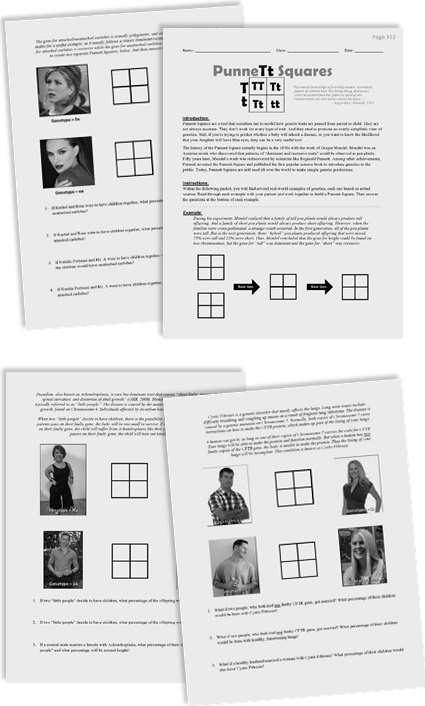
Today we did a quick lesson on Punnett Squares. I don’t like to make this a major topic; in my opinion, Punnett Squares tend to promote an overly simplistic view of genetics. So I like to teach them for what they are, a quick way to make simple genetic predictions.

I started off by telling the story of how Gregor Mendel discovered dominant and recessive genes through his experimentation with pea plants. Then we completed a packet that included other genetics examples, like attached/unattached earlobes, the dwarfism gene, and cystic fibrosis. Students had to figure out which gene was dominant, fill out a Punnett Square, and then make predictions about the offspring.

Resources:
December 4 – Punnett Squares (pg312).docx

Making Babies – Day 2

MBD2

Summary:
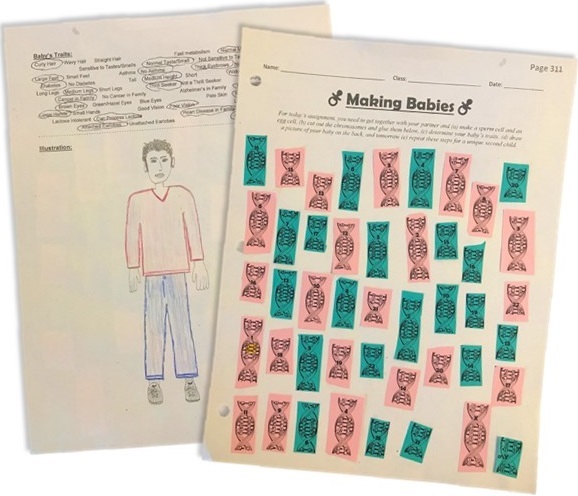
Today was the second and final day of our “Making Babies” project. Students began by finishing their sperm and egg cells (any absent students were given filled-in copies, as posted below). Then they cut out all 46 chromosomes and glued them on Page 311. This including flipping a coin to determine whether the father would pass on an X or a Y. Then they determined the baby’s traits by looking at the genes located on each chromosome. They finished off by drawing a picture of their baby on the back. When finished, each pair of partners should have a total of two (hopefully) healthy babies.

*I squeezed this project into two days, but I partly regret doing so. It should have been a three-day project that moved at a slower pace. I think a teacher with 1-hour periods could do the project over two days, but any teacher with 45-minute periods (like me!) should probably take a full three days.

Resources:
December 1 – Making Babies (pg311).docx
December 1 – Filled-In Sperm and Egg Cells.pdf

Making Babies – Day 1

.
Summary:
Today we went on a field trip to see the movie Wonder. It was a fantastic film. When we got back, we completed the first day of our “Making Babies” project. Students paired up and assigned one partner as the mother and one as the father. Then they got Page 305 – The Code for Me (their genetic code) out of their binder. Then, by copying alternating lines of the code, they made sperm cells and egg cells. Each sperm cell contained only 23 chromosomes; they passed on a mixed version of each chromosome pair. The same was true for the egg cells. Each partner made two. Tomorrow, they will be ready to combine the cells and make their babies.

Resources:
November 30 – Sperm Cell.pptx
November 30 – Egg Cell.pptx