Unit 3 Test

Unit 3 Test

Summary:
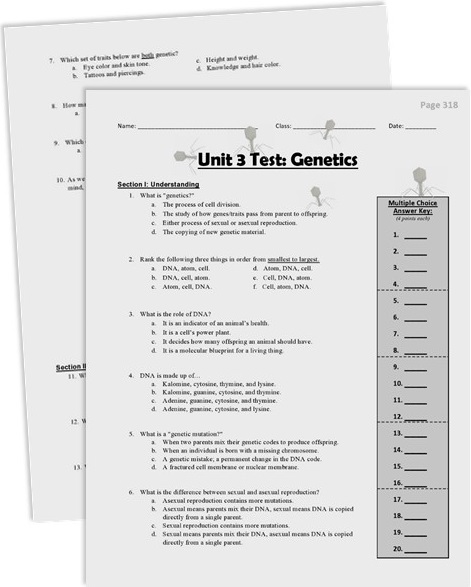
After today, we are officially done with Unit 3. Students took the Unit 3 Test today, and overall the scores looked good. The test covered everything from DNA and Punnett Sqaures to viruses and vaccines. It feels great to be done and I think everyone is just about ready for vacation. After Christmas, we will continue on to Unit 4: Evolution.

Resources:
December 19 – Unit 3 Test (pg318).docx

Review Day

.
Summary:
Today was our review day prior to tomorrow’s Unit 3 test. We played one of my favorite review games, called “trashketball.” Students take turns answering review questions. If they get a question right, they earn a shot at the basket. Or actually baskets. The different baskets are worth 1 point, 2 points, 3 points, and 8 points, and they vary in size. It was a fun day all around. Tomorrow we will take the Unit 3 Test.

Resources:
None

Outbreak! – Day 5

— Day 1 — Day 2 — Day 3 — Day 4 — Day 5 —

.
Summary:

Today was the fifth and final day of the “Outbreak!” project. And we focused on the most important task of all: producing a vaccine. We began by reviewing the Jonas Salk story. Then we walked through the basic steps of vaccine-making as a class (grow the virus, filter it into liquid form, freeze it with formaldehyde, and inject it into patients). Then each group set about making their own vaccine. The procedure for doing so will be the last section in their lab report.

Of course modern vaccine-making is more complicated. Growing viruses is tricky. And “freezing” them doesn’t always work. And they don’t use formaldehyde anymore because of its toxicity. But to me, those are just details. The real lesson in this project is much bigger than that. By giving people a deactivated or attenuated version of a virus, you can train their immune system to recognize the disease without them ever having to get sick. That is the heart of the Jonas Salk story and the heart of this project. His discovery was genius. And it has saved millions upon millions of lives.

Resources:
December 12-15 – Outbreak! (pg317).docx
Outbreak Project Example Lab Report.pdf

Outbreak! – Day 4

Day 1Day 2Day 3 — Day 4 — Day 5

.
Summary:
Today was the fourth day of the “Outbreak!” project. We began by discussing the reproduction of the virus; this is an important topic when you’re preparing to make a vaccine. Specifically, there were three questions we tried to answer: Are we sure it’s a virus? Is it reproducing sexually or asexually? And is it mutating?

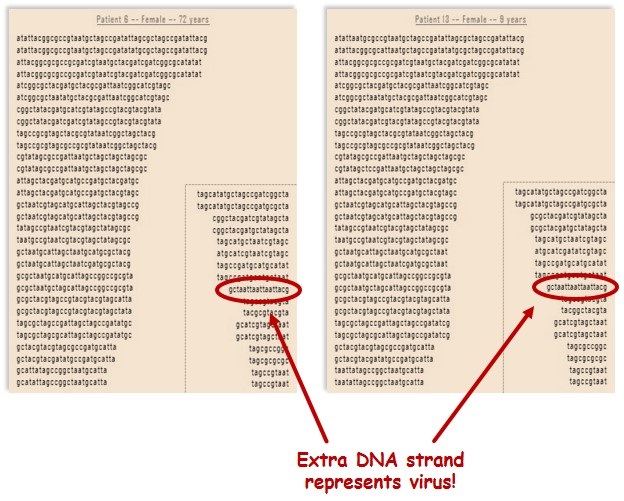
The first two questions were rather obvious. Yes, it’s a virus; we determined that yesterday. And of course it reproduces asexually (by forcing the host cells to make copies). But the last question was trickier. Is it mutating? By comparing the virus code found in Patient 6 to the one found in Patient 13, we were able to conclude that the virus was not mutating. The code was exactly the same. And that’s great news. That means our T-cells will have an easier time managing it. And it also means we would only need one vaccine.

Resources:
December 12-15 – Outbreak! (pg317).docx

Outbreak! – Day 3

Day 1Day 2 — Day 3 — Day 4Day 5

.
Summary:
We started off today with me handing back the DNA codes from the overnight lab. Some codes came back complete, some didn’t. I gave two complete codes to all of the groups who did an excellent job with yesterday’s lab. For the group who did an okay job, I handed back one complete code and one that said “bad sample.”

OBD3

After that, we discussed what the DNA codes meant. A healthy human is supposed to have a code with 46 pieces of DNA*. Our codes had 47 pieces. So we concluded that one of the pieces must be the virus. Upon further inspection, we also remembered that the human chromosomes came in pairs. What we really had was a DNA code with 23 pairs of code and one extra. That lone DNA strand toward the bottom of the paper? That must be the virus!

This was a great “Aha!” moment for students. After all, viruses are DNA invaders. The fact that both patients had the same additional piece of code (a) suggests that we are dealing with a virus and (b) would probably tell us what type of virus it was. After our discussion, students got to work typing up their lab reports.

*Of course, in real life, each chromosome would be millions of letters long. But hey, I was trying to save paper!

Resources:
December 12-15 – Outbreak! (pg317).docx
December 13 – Patients 6 and 13 DNA Codes.pptx

Outbreak! – Day 2

Day 1 — Day 2 — Day 3Day 4Day 5

.
Summary:

Today was the second day of the “Outbreak!” project. The outbreak was under control, so students set about trying to figure out exactly what this disease was. Students took two prepared blood samples and extracted the DNA from each. The thinking was that, if this was in fact a virus, we would be able to detect the virus DNA mixed in with the human DNA.

So students adapted the DNA Lab that we did a few weeks prior, but this time they applied the steps to the blood samples. After mixing in detergent and enzyme, and then adding a layer of rubbing alcohol, they were able to isolate the DNA from the blood samples. Then they submitted a vial of each DNA sample to the overnight lab* so that the DNA could be decoded. Tomorrow they will get back their fully decoded sample which will hopefully contain the code for the virus!

*The idea of decoding an entire DNA sample overnight is a little far-fetched, but hey, it’s 2034, so let’s go with it!

Resources:
December 12-15 – Outbreak! (pg317).docx

Outbreak! – Day 1

— Day 1 — Day 2Day 3Day 4Day 5

This slideshow requires JavaScript.

Summary:
We started one of my favorite projects today, the capstone project for Unit 3, called “Outbreak!” During the project students are asked to diagnose a deadly disease that is spreading throughout their town and to find a cure.

We started today with a PowerPoint introducing the project (posted below). It began with a video from Bill Gates explaining why he worries about virus outbreaks. Then we learned about how viruses are tiny cell invaders, injecting their DNA or RNA and hijacking your cells. Next I told them the story of polio, a deadly virus that was effectively cured in 1953 by Jonas Salk. He invented a way to “freeze” the virus and give it to patients, thereby teaching their immune system to recognize the virus without subjecting the body to its living form.

Then we introduced the premise of this week’s project:
        “The year is 2034. A deadly disease has struck the town of Marshfield along with the majority of Massachusetts. As of now, the disease has only been found in 1-2% of the population, but it is spreading quickly. By the end of the week, it is expected to spread to the cities of Boston, Providence, and perhaps even New York. The Center for Disease Control (CDC) has been called in to try to slow the spread of the disease and to find a cure.
        If made quickly, a vaccine could keep fatalities in the hundreds or thousands. Without one, the death toll could reach several million. Your job during this project is to identify the disease, slow its spread, and eventually find a cure. Your final lab report will include instructions on how to make the vaccine, and the report should be shared with the CDC and local governments. The clock is ticking.”

Students this week will be asked to (1) control the outbreak, (2) test infected patients, (3) examine their DNA, (4) analyze the disease’s reproduction, and (5) produce a vaccine. Each of these tasks will be completed on subsequent days. At the end of today’s class, students wrote down their recommendations for controlling the outbreak. These included closing school (no surprise there!), National Guard food deliveries, and even quarantining infected patients.

Resources:
December 11 – Outbreak! Notes (pg316).pptx