howmuchwillithold

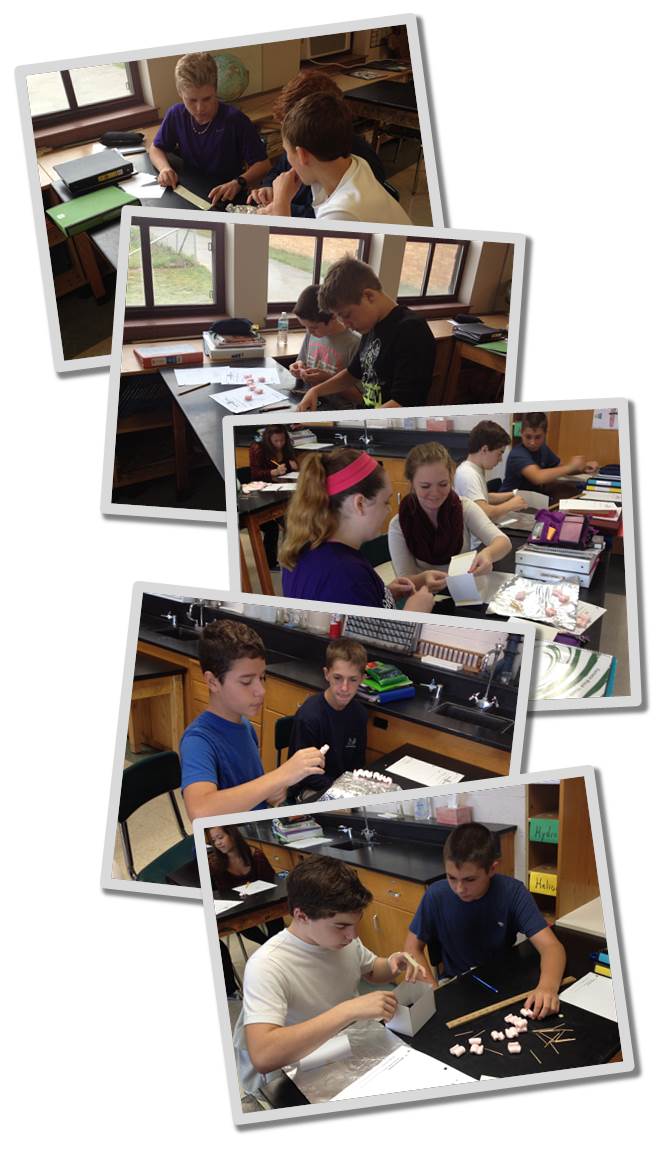
Today students completed the second half of the How Much Will It Hold? lab. By measuring and weighing different vessels and then utilizing the density formula, students were able to predict how much weight a given boat could hold before sinking.

Of course it was tricky. Using such a complex formula is hard enough, not to mention factoring the real-world variable that could change your answer, like wet bolts, non-perfect shapes, and wavy water. Still, most students were very close with their predictions and were able to win at least one piece of candy. For more discussion on how to figure out how much a boat could hold, here are Erica and Cassidy explaining some of their work.

Error
This video doesn’t exist

September 28 – How Much Will It Hold Lab Day #2 (pg116)

The Finest Hours Day

We took the day off from regular science classes today to take part in the school-wide celebration of The Finest Hours, our summer reading book. Students participated in themed lessons that included nautical flags, maritime navigation, and a presentation from the book’s author, Casey Sherman. Regular science classes will resume on Monday.

How Much Will It Hold?

We began today with a check-in regarding the students’ Boats Essays, which are due on Monday. Then we revisited yesterday’s lab. For any well built boat, one that wouldn’t leak or crumple, could there be a way to calculate how much it would hold?

The answer, of course, is yes! It’s just an application of the density formula!

boatsdensityformula

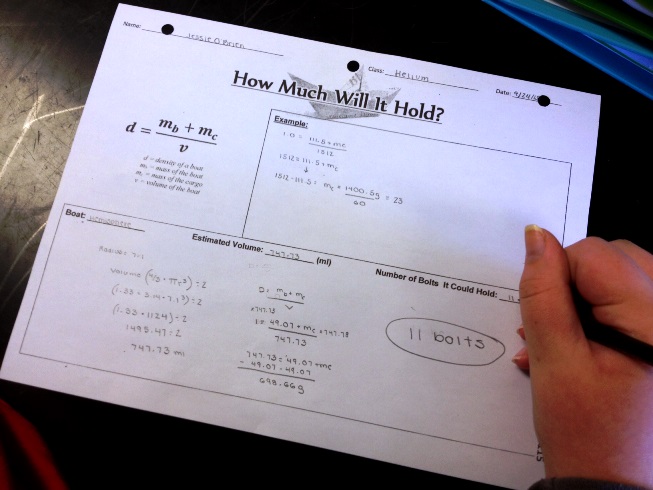
Using the formula is easier than it looks. First, you weigh the boat to find the mass in grams. Then you calculate the volume of your boat in milliliters. And for any boat, the density just before it sinks is 1.0 g/ml, so you can fill that in too. The only variable you don’t know is “mc” (the mass of the cargo).

For the next two days in class, students will be attempting to answer the question “How Much Will It Hold?” for seven different objects. They will measure the object’s volume, weigh it, and solve the equation to figure out the maximum mass it could support before sinking. Then they will divide by 60 to try to predict how many of the 60 gram bolts that could be. At the end of class on Monday, we will get out the aquarium and test each of the seven objects to see if their predictions were right.

jessieswork

September 24 – How Much Will It Hold Lab Day #1 (pg115)

Testing Our Boats

IMG_1669

Today students finally got to see their boats in action. The competition in each class was fierce. We added 60 gram bolts, one at a time, and the last boat to sink was the winner. Congratulations to Kate Gemmill and Meaghan Parsons; their boat held 21 bolts (a mass of 1260 grams), the most in the cluster!

The key to winning the competition came down to three things. First, your boat had to hold it’s shape (any crumpling would reduce its volume). Second, your boat couldn’t leak (any leak would have added to the mass). Third, and most importantly, your boat needed to have a large volume in order to support a heavy weight and still maintain a low density. For more discussion regarding these three points, watch Mr. A’s explanation below.

Error
This video doesn’t exist

Remember, your homework is to begin work on your Boats Essay (due Monday). The instructions are on the back of Page 114. And if you’d like to use pictures in your essay, please visit the link below.

Click here to see pictures of our boats in action!

Intro to Boats

nimitz

It seems amazing that the Nimitz Aircraft Carriers, giant metal boats weighing over 200 million pounds, can float. But in fact, regardless of size, boats follow the same rules of flotation. If their density is above 1.0 g/ml, they sink; if their density is below 1.0 g/ml, they float.

Submarines are a unique application of these rules. They can control their own flotation by filling their ballast tanks with either air or water. By filling them with water, they increase their mass, thereby increasing their density. By pumping the water out and filling the tanks with air, they lower their density. This principle has been well understood since 1776, when the first military submarine was built during the revolutionary war.

turtle

This week, we will begin our Unit 1 Capstone Project, which will be a boat-building competition. Students will work in teams of two and, using the same basic materials, attempt to build a boat that can hold as much weight as possible. The only materials they are allowed to use are a piece of paper, 30 cm of masking tape, a square sheet of tinfoil, four index cards, 12 Styrofoam peanuts, and 20 toothpicks. Last year’s winner held 32 heavy metal bolts (60 grams each). Let’s see if we can set a new record this year!

September 21 – Intro to Boats (pg112)

Review Carousel

Next week we will be beginning our first Real-World Capstone Project. For Unit 1, that means our yearly boat-building competition. But first, we took a pause to review what we have learned so far. Today in class, students took part in a Review Carousel. Students rotated about the room answering different questions about mass, volume, and density, etc. Every four minutes the bell rang and students moved to the next table, correcting their previous work and answering the next question.

reviewcarousel

Any student with questions about today’s lesson should review the questions and answers posted in the PDF below. Have a nice weekend, everyone!

September 18 – Review Carousel