Mystery Liquids (Day 3)

My apologies for being out today, everyone. I have a wicked cough and probably should not be around other humans…

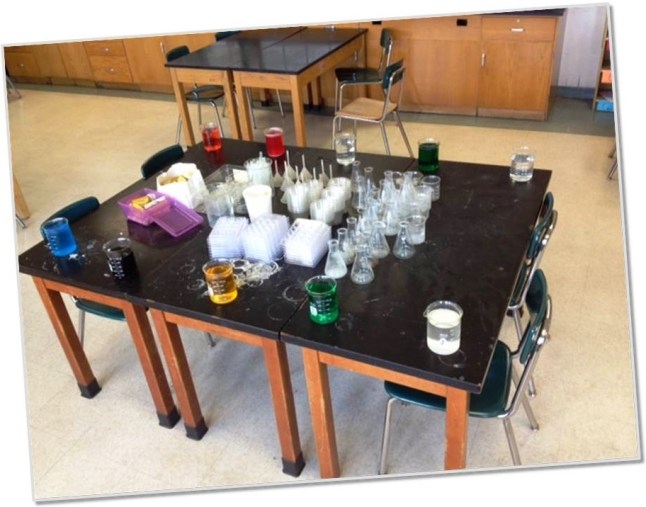
Today students were expected to finish their “Mystery Liquids” lab reports. That would include them finishing up any testing from yesterday, writing a final draft of their report so far, and adding a conclusions paragraph. Remember, our lab report should have six sections: Goal, Hypothesis, Materials, Procedure, Results, and Conclusions. Any report not finished in class should be finishing for homework. If are having trouble imagining what your final draft should look like, click here to see a great lab report from last year (although, keep in mind last year we used different liquids).
November 17-19 – Mystery Liquids (pg312)

Mystery Liquids (Day 2)

Today was the second day of our “Mystery Liquids” lab, the day where students got to put their procedures into action. Through a combination of PH testing, observation, and reaction tests, students tried to classify each of the ten liquids. This wasn’t so easy. Not all acids are strong or produce big reactions; and bases can be equally difficult. Not to mention the neutral compounds that don’t react with anything!

Nevertheless, most groups were able to collect enough data to classify each of the liquids. Tomorrow, they will write a final draft of their lab report ending with their conclusions. At the end of class tomorrow, the answers will be revealed.

November 17-19 – Mystery Liquids (pg312)

Mystery Liquids

Today we began a three-day experiment called “Mystery Liquids.” Students began designing their own lab with the goal of classifying ten mysterious liquids as acidic, basic, or neutral. They needed to use what we learned yesterday (characteristics of acids & bases, the PH scale, acid/base reactions, etc.) to design an experiment that would allow them to identify each of the liquids.mysteryliquids

The catch is that their grade will be, in part, determined by their use of PH strips. Simply testing the PH of all ten liquids would be too easy; the highest that could earn them would be a B+. If they agree to only use five PH strips, they can earn an A. If they only use one PH strip, then they can earn an A+. Their challenge will be to classify some of the liquids using other means. That could be through observation, or reaction tests, or perhaps a mix of the two.

November 17-19 – Mystery Liquids (pg312)

Acids & Bases Notes

PHscale

In class today, students learned about a specific family of chemical reactions called “Acids & Bases.” Acids are one half of the story; they are sour-tasting compounds with a PH under 7. Bases are the opposite of acids; they tend to be bitter-tasting and slippery, and they have a PH above 7. The PH scale is simply the scale that was invented to measure how strong acids and bases are. The closer you get to either end of the scale, the stronger the compounds are.

When an acid and a base are combined, the result is a chemical reaction. For example, today in class we combined Tums (CaCO3) with stomach acid (HCl), just like a person with heartburn might do. The result was a bubbling chemical reaction that produced a gas (CO2) but which also neutralized the stomach acid, making the acid less acidic. With enough Tums, you could turn a powerful corrosive like stomach acid into something as harmless as salt water!

November 16 – Acids and Bases Notes (pg311)

Your HW tonight is to take the Unit 3 Checkpoint Quiz; please click here for access. 

Where’s the Evidence? (Day 3)

sugarandflame

Today was the last day of our “Where’s the Evidence?” lab, and we saved the best for last. Today, students heated sugar (sucrose: C12H22O11) and observed the resulting chemical reaction. They piled the sugar onto a piece of tinfoil and held that foil directly over a burning candle. After a while, it began to melt and then react; the white sugar turned dark brown and seemed to release smoke into the air.


It turns out that the “smoke” was actually steam, the gaseous form of H2O. When heated, sugar molecules spontaneously decompose, and the black residue left behind is charcoal (carbon). Kind of sheds a new light on crème brulée, doesn’t it?

November 13 – Where’s the Evidence Day 4 (pg309)
November 13 – Day 4 Post-Lab (pg310)

Where’s the Evidence? (Day 3)

makingmilk

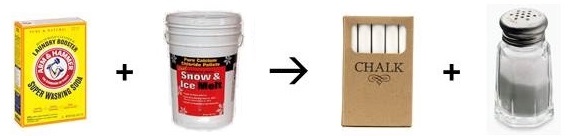
Today was the third day of our “Where’s the Evidence?” lab. Today’s reaction was called “making milk.” The students combined ice melt (CaCl2) with washing soda (Na2CO3). By dissolving the ice melt and washing soda in two separate beakers, students started with two clear liquids. Upon mixing them, the liquid suddenly turned bright white, similar to the color of milk.

It wasn’t magic; it was a chemical reaction. The sodium and calcium switched places, producing table salt (NaCl) and chalk (CaCO3). The chalk was what gave the mixture such a bright white color. A video of the reaction can be seen below.

November 12 – Where’s the Evidence Day 3 (pg308)

Where’s the Evidence (Day 2)

bluegooanimation

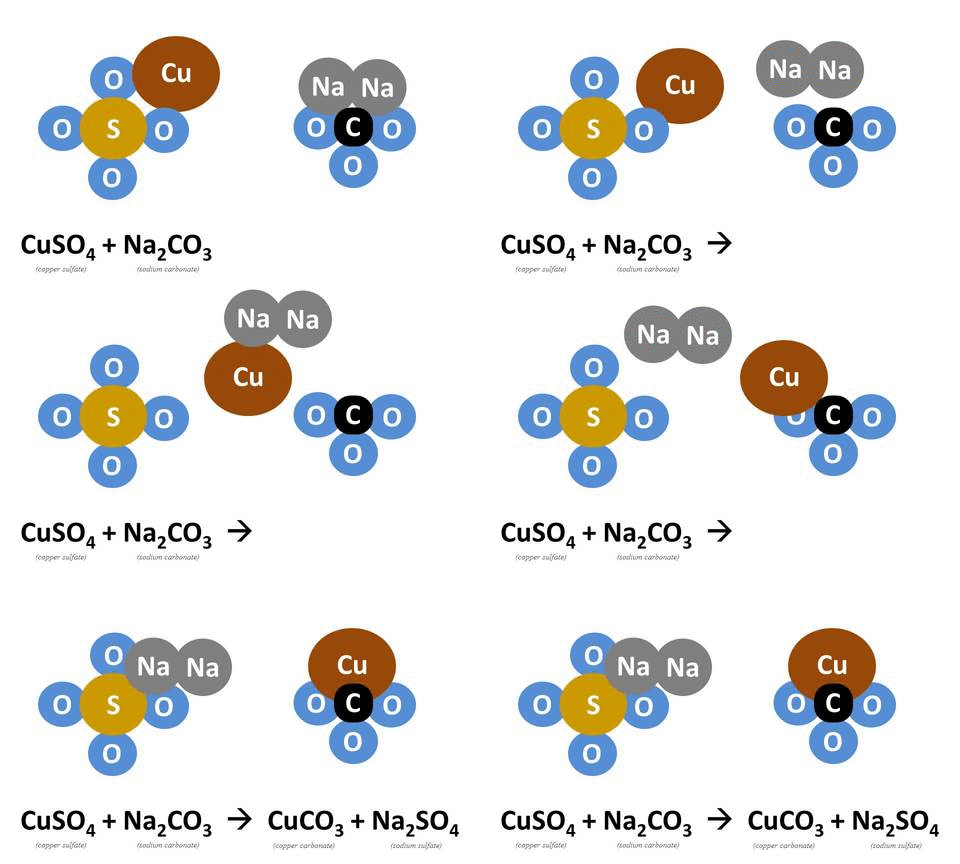
For the second day of our “Where’s the Evidence?” lab, students combined copper sulfate with sodium carbonate. The two compounds were mixed with water and then combined in a test tube, producing a chemical reaction. The copper atom replaced the two sodium atoms, switching places and producing two new compounds: copper carbonate and sodium sulfate. The result was a cloudy blue liquid called “the blue goo.”

November 10 – Where’s the Evidence Day 2 (pg306)
November 10 – Day 2 Post-Lab (pg307)