Tides

tides
Back in the 1200s, John Abbot published “The Flood at London Bridge,” the first accurate prediction of tidal changes in the ocean. But Mr. Abbott was never able to explain why the tides changed. Many people thought that the Earth itself might be alternately inhaling and exhaling sea water.

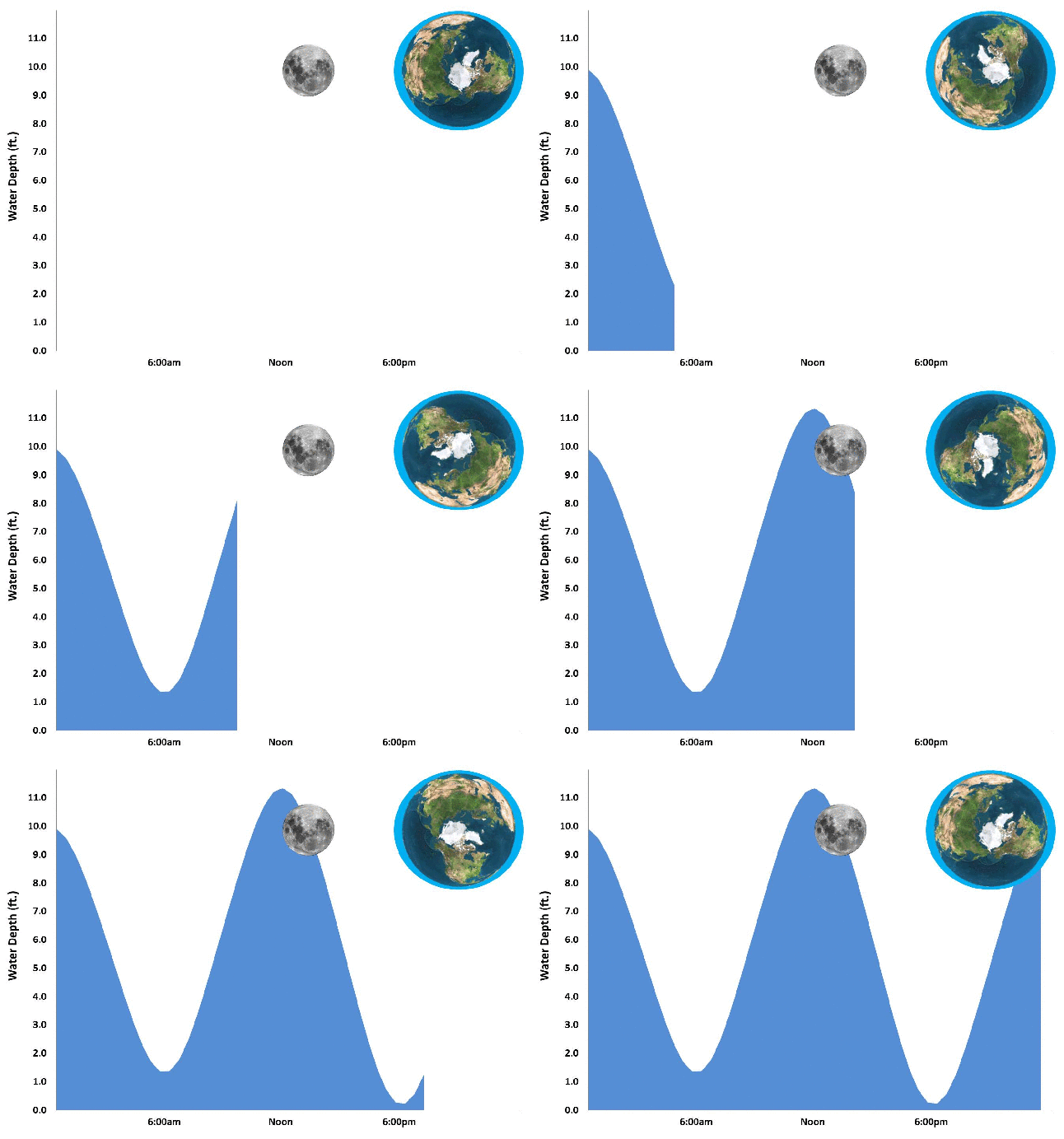
Today we know that tides are caused by gravity from the moon (68%) and the sun (32%). Because water is a fluid, it can be moved rather easily by gravity. When the moon is directly overhead, it is powerful enough to lift up the water in the ocean below it by about 6 feet. The flowing water from each adjacent side of Earth leaves behind a low tide, while on the far side of Earth there is a “slightly-lower high tide.”

highandlowtide

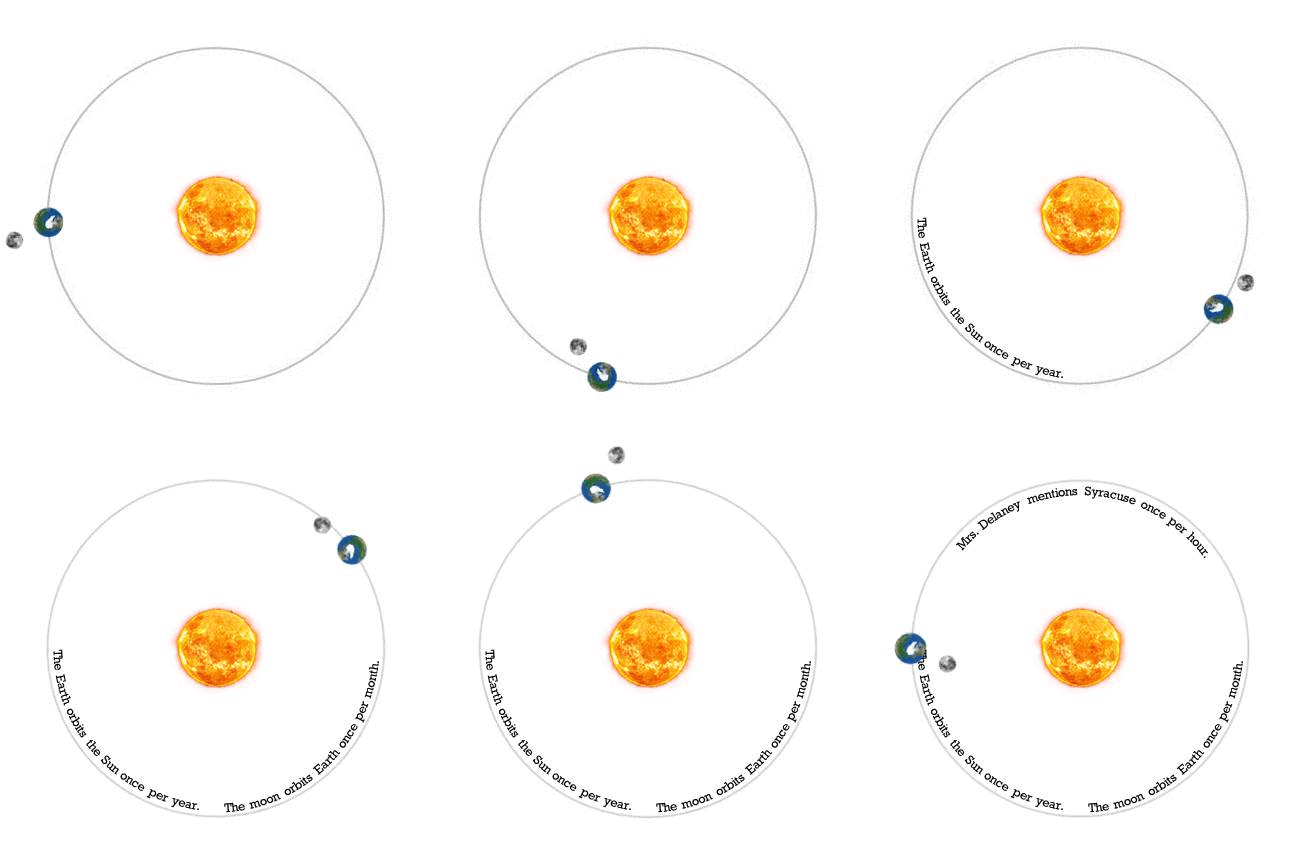
Because Earth spins a quarter of the way around every six hours, coastal locations experience high and low tide twice each per day, roughly six hours apart. But it’s not exactly six hours, of course, because the moon is moving too. And that is how tides work. Nice job today, everyone. John Abbott would be proud!
January 11 – High and Low Tides (pg406)

Astronomy Myths

This slideshow requires JavaScript.

Today the students realized that, after yesterday’s lesson, they now know more about the Sun-Earth-Moon Relationship that even the Ancient Greeks! In fact, if you look at the nine myths above, you will realize that most ancient cultures had incorrect explanations for what they observed in the sky above.

For example, we now know that night and day are caused by the Earth’s spinning, that the Earth is in fact round, and that the seasons are actually a result of Earth’s tilt.

However, none of the students could fully explain moon phases, or high and low tide, or eclipses, or flood tides. Why does the moon seem to grow larger each month? Why does the depth of water in the ocean change daily? Why do eclipses happen so rarely? And why is there so much flooding in Brant Rock if a snowstorm hits during the full moon?

Good questions. Those will be the topics for next week!

January 8 – Astronomy Myths (pg405)

Sun, Earth, Moon

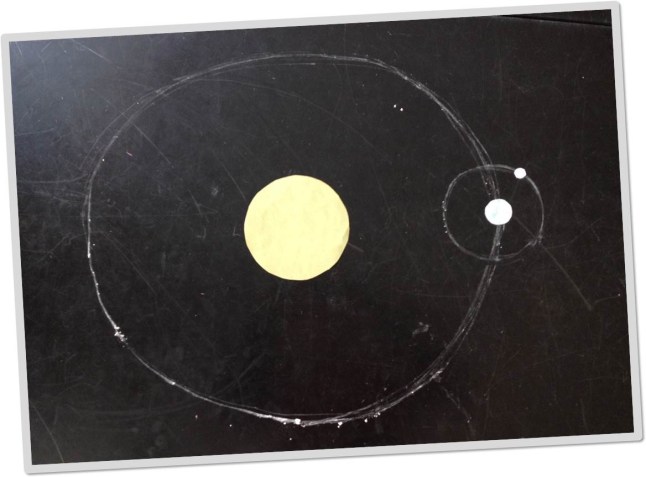
SunEarthMoonUnderstanding the Sun, Earth, Moon relationship is the most important part of Unit 4. So before teaching my students about it, I had them make a hypothesis about their relative sizes, distances, and movement. Most students created a model like this one below, similar to what is often found in science textbooks.SEMmodel

But the true scale of our solar system defies common wisdom. In reality, if the sun were shrunk to the size of a softball, the Earth would be about the size of a pencil tip and the moon would be the size of a grain of sand. Not only that, at that scale the objects would need to be placed about 70 feet apart! And what lies between is the vast, empty expanse that we call “space.”

January 7 – A Sun, Earth, Moon Model (pg404)

Gravity Drop – Day 2

gravitydropday2

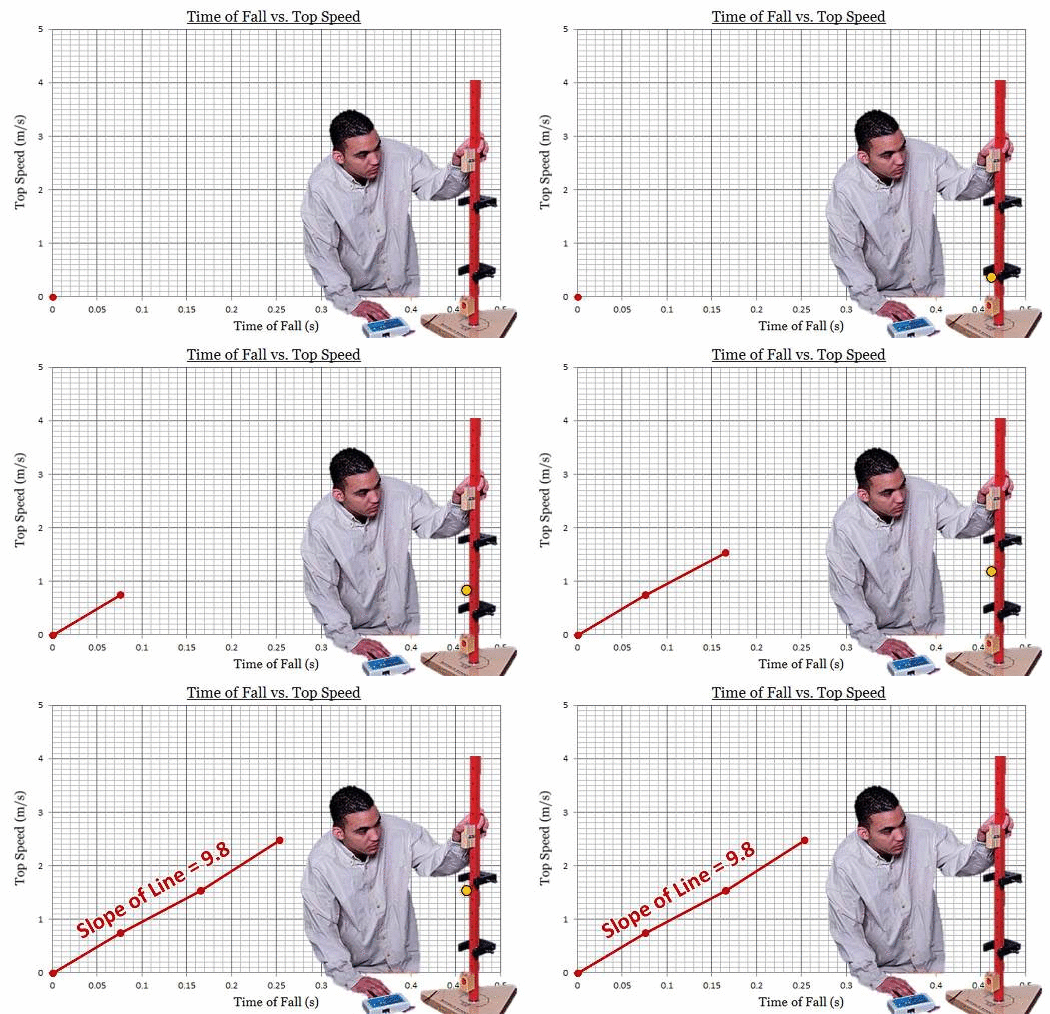
Today was the second day of the gravity drop lab. Students attempted to prove, using our simple equipment, that Earth’s acceleration due to gravity is indeed 9.8 m/s per second. This time, they measured the marble’s “time of fall” and compared it to the marble’s “top speed” at the end of the fall. They graphed their data, and most groups found a slope close to 9.8.

Of course, doing the experiment in a room full of air with shaky equipment didn’t yield perfect results. But that’s not the point. The point is that we now know how scientists solved the problem of measuring Earth’s gravity in the first place!

Also, as a reward for those of you who check the website every night, I am offering a prize tomorrow to the first person who sees me during homeroom and whispers the password “lunar.” Goodnight, everyone!

January 6 – Gravity Drop Day 2 (pg403)

Gravity Drop – Day 1

Today students got the chance to test gravity experimentally. They used a photogate to measure the speed of two falling marbles. Both were the same size, but one was made of metal and the other was made of plastic. The metal marble was five times heavier!

gravitydropday1

Contrary to popular belief, heavy objects do not fall faster. Both marbles experienced the same pull of gravity and both accelerated toward the ground, their speeds increasing at roughly the same rate. The reason heavy objects seem to fall faster in because they are less affected by air resistance. Tomorrow, we will take this experiment to the next level, attempting to prove that Earth’s gravity really does accelerate objects at 9.8 m/s per second.

January 5 – Gravity Drop Day 1 (pg402)

Gravity

Today we began Unit 4: Sun, Earth, Moon. For the next few months we will be studying everything from black holes to interstellar travel to moon phases and lunar eclipses. But before we begin, we must first study the science of gravity.

Gravity can most easily be defined as the force that pulls objects together. However, in reality, it’s more complicated than that. The strength of gravity depends on the mass of the planet, star, moon, or other object. Earth’s gravity, for example, is fairly strong; it produces an acceleration of 9.8 m/s per second in all objects. Yes, you read that right. All objects, even a bowling ball falling beside a feather, experience the same pull of gravity!

When air is taken out of the equation, we can see that gravity affects everything equally. But it’s strength can vary greatly from planet to planet. Mars, for example, has only about 38% of Earth’s gravitational pull, while the more massive Jupiter has 2.5 times the gravity of Earth. For the second half of class, students learned how to calculate what their weight would be (in lbs.) on six different objects in our solar system.

gravitynotes

January 4 – Gravity Notes (pg401)

Trimester Exam

Today was the Trimester 1 Exam, which actually covers the first three units out of seven: Unit 1 – The Metric System, Unit 2 – Basic Chemistry, and Unit 3 – Chemical Reactions.

Overall, the scores looked quite good. Great job, everyone. Enjoy your holiday break!