Where’s the Evidence? – Day 2

.
Summary:
Today was the second day of the “Where’s the Evidence?” lab. It followed the same format as yesterday: students warmed up by completing the pre-lab, then did the lab, then completed the post-lab for homework.

Today’s experiment was called “The Blue Goo.” It asked them to mix copper sulfate solution with sodium carbonate solution. Upon mixing, the copper atom (Cu) switched places with the sodium pair (Na2), creating two new compounds. The first (sodium sulfate) was hard to see. The second (copper carbonate) showed up as a light blue, cloudy solid, suspended within our test tubes. Copper carbonate is actually the compound that gives the Statue of Liberty its famous blue-green color.

Resources:
October 24 – Where’s the Evidence Day 2 (pg213).docx
October 24 – HW Day 2 Post-Lab (pg214).docx

Where’s the Evidence? – Day 1

.
Summary:
We’ve covered several difficult topics in the past few lessons. For the next three days, we’ll simply practice. It will be a three-day lab called “Where’s the Evidence?” where students will be looking for evidence of chemical reactions. And each day will follow the same format: students will begin with a few pre-lab questions, then do the the experiment, then complete the post-lab assignments for homework.

The first day’s experiment involved mixing hydrochloric acid and sodium carbonate. The reaction bubbled and produced heat. And it left behind three new compounds: water, carbon dioxide, and table salt.

Resources:
October 23 – Where’s the Evidence Day 1 (pg211).docx
October 23 – HW Day 1 Post-Lab (pg212).docx

Chemical Reaction Equations


Summary:

Today I began by showing students the “Electrolysis of Water,” where electricity is used to rip water molecules apart. I showed them this experiment to illustrate how an equation can be used to describe a chemical reaction.

reaction equations

It’s almost like learning a new language, I told them. The chemical formulas in the equation tell you what to draw and the coefficients tell you how many to draw. The equation above can be translated into a picture, as shown below.

Presentation1

Believe it or not, all three of these examples (the experiment, the equation, and the picture) showed students the same thing: when you electrocute water molecules, they divide into hydrogen gas (H2) and oxygen gas (O2). After this discussion, students practiced translating the equations into pictures using the worksheet below.

Resources:
October 20 – Chemical Reaction Equations (pg210).docx

Chemical Reactions


Summary:

Today we introduced one of my favorite topics: chemical reactions. We defined a chemical reaction as “does change the chemical formula; creates a new substance.” We also discussed how, because you can’t actually see the atoms, it can be hard to distinguish between a chemical reaction and a basic physical change. So I taught them to look for four clues: color change, temperature change, bubbling, and glowing. If you see more than one of these four clues, there’s a good chance you’re looking at a chemical reaction.

After this discussion, students completed a worksheet (posted below) where they tried to classify changes as physical or chemical. At the end of class, we corrected their work.

Resources:
October 19 – Chemical Reactions (pg209).docx
Wine Into Water Demo.docx

Phase Changes Lab


Summary:
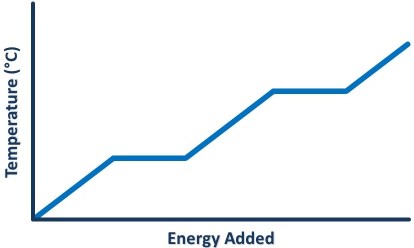
Today in class, students completed the Phase Changes Lab. Because nothing enthralls 8th graders like watching ice melt! They started off with a thermometer frozen within a block of ice, then put it into a beaker, and then heated it for 30 minutes. All the while, they kept track of the temperature.

phasechangesgraph

Their graph ended up looking like the one above. As the ice warmed, it’s temperature rose, up until its melting point. Then the temperature plateaued during the melting process. Then it rose again, followed by another plateau during boiling. Afterward, students completed the post-lab questions for homework.

Resources:
October 18 – Phase Changes Lab (208).docx

Phase Changes

This slideshow requires JavaScript.

Summary:
Today we introduced the concept of “phase changes.” I began the lesson with a brief description of why certain molecules are magnetic. Water is, of course, the classic example. Because the electrons in the hydrogen atoms are bonded with the oxygen atom below, the top of a water molecule takes on a small positive charge, while the bottom takes on a small negative charge. This lesson is not necessarily part of the 8th grade curriculum, but it is important background for understanding phase changes.

After that, we went through a PowerPoint on phase changes (posted below). It explained all five phases of matter, why molecules tend to clump together, and the names of the four common phase changes (melting, freezing, boiling, and condensing). At the end of class, I decided to spice things up a bit with a dry ice demonstration.

Resources:
October 17 – Phase Changes Notes (pg207).pptx

Heat Matters

heatmatters

Summary:
Today we introduced the topic of heat, particularly as it relates to chemistry. The focus of the lesson was to get students to visualize heat as motion that is present within atoms and molecules. But because atoms are too small to see, this can be a tough idea to imagine. We went through a PowerPoint (posted below) that defined heat, explained how it is measured, and presented three different ways that heat can be transferred.

Resources:
October 16 – Heat Matters (pg206).pptx