Today is an early day, so we only see the students for about 20 minutes… just enough time to go over last night’s homework. I will post the answers below. If you have any questions please email namendolare@mpsd.org or make arrangements to stay after school!
Changes in Density
You mean it’s not always 1.0 g/ml? Water’s density can change?
Yes! In fact, every substance can undergo a change in density. When a substance is heated, the atoms and molecules vibrate, which increases the substance’s volume without changing its mass. As a result, its density goes down. When a substance is cooled, the opposite happens, and the density goes up. (Ice crystals are a notable exception this rule.)
Today in class, students took part in a lab that tested this effect. They observed how hot water floated because of this change in density. All you needed was some hot water, a pipette, and a bit of food coloring. They repeated the test with cold water and saw the opposite effect. Then they tested salt water. Because salt dissolves in water, filling the spaces between the water molecules, it makes the water heavier without affecting its volume. The result? Salt water has a higher density. Because of these factors, it is actually easier to float a boat in cold, salty water than it is in warm, fresh water!
Error
This video doesn’t exist
Thanks for the help with the above video, Phoebe. And remember everyone, tonight’s homework is to finish the Post-Lab Conclusions.

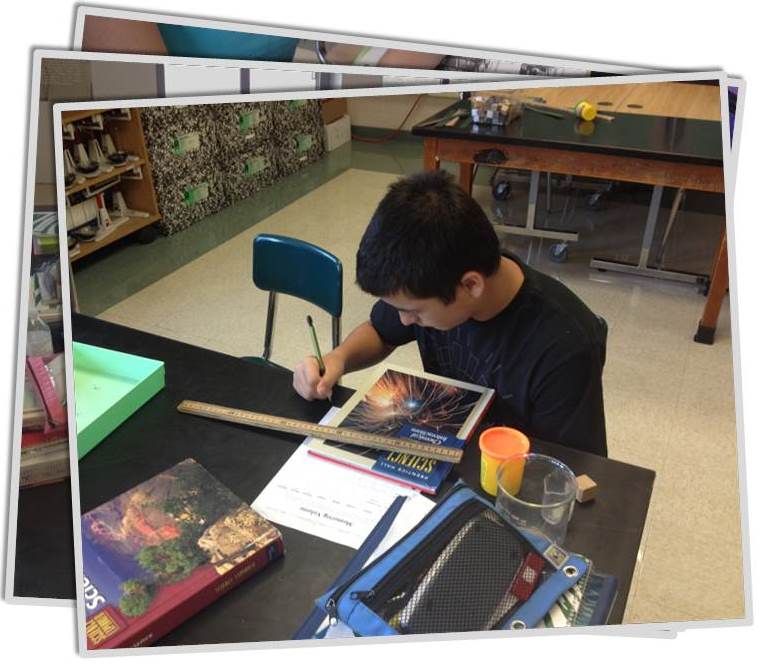
Today was a practice day for students regarding yesterday’s topic of “density.” Students broke into groups of two and practiced determining the density of eight different objects. This was done by using a scale to measure the object’s mass, using a ruler to help calculate it’s volume, and then dividing. Of course, density = mass ÷ volume.
But some objects were tricky; rocks don’t come in neat cubes or perfect cylinders. So students dropped the rocks into a graduated cylinder full of water and measured how much the water level rose, thus finding the rock’s volume.
When they were done measuring and calculating, the last step was determining flotation. Luckily, there is a convenient trick for determining if an object will float in water. If it’s density is below 1.0 g/ml, the object will float. If it’s above 1.0 g/ml, the object will sink. There were no surprises today. Students discovered that a wooden object will float and a metal object will sink. But they also discovered the science behind why!
Density Lecture
When you ask someone which is heavier, a rock or a feather, most people will say it’s the rock. But in truth, that’s not always the case. What if you compared a tiny pebble to a whole truckload of feathers? What people really mean, when they say, “rocks are heavier,” is that rock has a higher density.
Today in class, students listened to a lecture about the concept of density. It’s an important one; a boat’s density is the difference between a peaceful cruise and a shipwreck disaster. We can calculate an object’s density using the formula d = m/v. This is the same principle that guides the flight of hot air balloons, keeps icebergs afloat, and makes oil spills practical to cleanup (if all the oil sank, we’d be in big trouble!)
Afterwards, students used the density formula to calculate the density of vegetable oil, rubbing alcohol, maple syrup, water, and salt water. When mixed together, the liquids actually separate into predictable layers based on their densities. The higher densities sink to the bottle while the lower densities float to the top.

Tonight’s HW is the Checkpoint Quiz which can be accessed by clicking on the previous link. Just type in your name and answer the ten questions to see how you are doing so far in Unit 1.
The Mass of Water Lab
How many cubic inches make up a gallon? And how many pounds is a gallon of water? Darn it, I can’t remember! Luckily, things are much easier for us in the Metric System.

So far we have learned about lots of Metric units, but we haven’t studied their relationships. Believe it or not, it’s not a random jumble of units; it’s actually very well-organized. Today students completed The Mass of Water Lab (pg107) with the goal of figuring out how it all fits together. They measured a plastic cube that had a volume of about 15 cm3, and then they dropped it into a beaker of water. Guess what! The water level rose by 15 ml. The lesson? In the metric system, the units of cm3 and ml are equal.
Next the students weighed a graduated cylinder. Then they filled it with 30 ml of water and weighed it again. Guess what! The mass increased by 30 grams. The lesson this time? In the metric system, 1 ml of water weighs exactly 1 gram. I guess it’s not a random jumble after all.

What Is Mass?
What is mass? It’s not just a Sunday ritual for Catholics, it’s also a scientific concept. Mass is the amount of matter in an object.
It’s similar to “weight,” except that an object’s weight depends upon the amount of gravity present. For example, in outer space, objects are “weightless,” but they don’t lose their mass. In truth, the amount of mass just depends upon how much material makes up the object.

Today in class, students practiced using a scale to measure the mass of different objects. They used the unit of grams (g), the standard metric unit for mass, and then converted their answers into milligrams (mg) and kilograms (kg). Their homework tonight is to complete the Website Check — Hello everyone!!! — on the back of Page 106. Tomorrow, we will take this lesson a step further, in a much more involved experiment that proves how these basic metric units are all linked together.
September 10 – What Is Mass (pg106)
Volume
Volume is the amount of space an object takes up. And there are lots of different ways to measure it. You could use cubic inches, gallons, liters, or cm3.
In the Metric System, they have thankfully standardized these measurements. The cubic centimeter (cm3), which is usually used to measure solids, is exactly equal to the milliliter (ml), which is usually used to measure liquids. Thus, finding out how many liters of water could fit in a square tub is rather simple. You use centimeters to measure the length, width, and height of the tub. You multiply to find the volume in cm3, which is the same as milliliters. And you use your metric ladder to convert milliliters to liters.
In class today, students did exactly that. They found the volume of seven different objects in cm3, milliliters, and liters.
 www.MrAscience.com