Today in class, students finished making their Trimester 1 Study Guides. Tomorrow they will take the Trimester Exam. Remember to study hard, everyone!
Make Your Own Study Guides
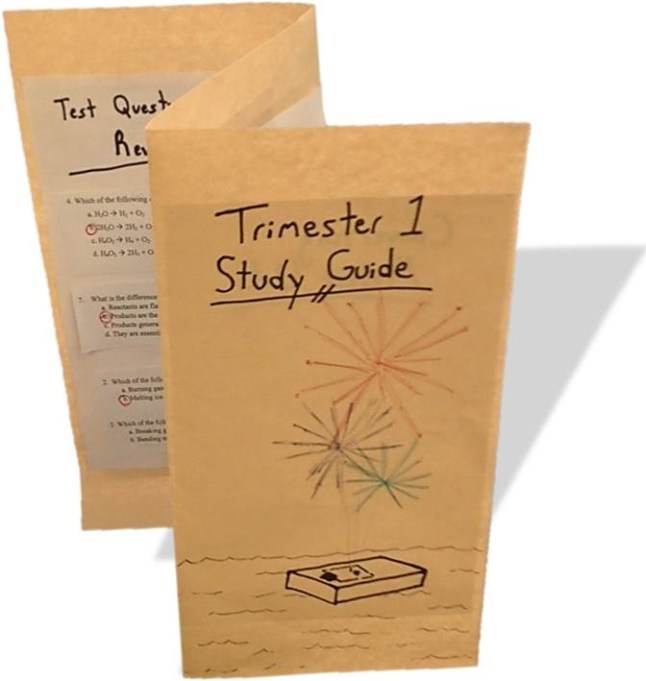
With the Trimester 1 Exam on Wednesday, students will be making their own study guides over the next two days to help prepare. Each student chose 4-5 topics that they think they struggled with the most from the list on Page 329. Then they set about the task of creating a study guide page for each of those topics, as seen in the picture above. They were also encouraged to review their Unit 1, Unit 2, and Unit 3 tests to reflect on the specific questions they got wrong. Odds are, some very similar questions will appear on the exam!
Mock Trial
Each class held a “mock trial” today, where one suspect from each class was tried for the crime of hacking into Mrs. Delaney’s grade book. For highlights, please see the above video. The results of the five trials are below.
Max Burum – Guilty
Jillian Gerard – Not Guilty
Nick Valianti – Not Guilty
Cassidy Sargent – Not Guilty
Lauren Camire – Guilty
It was an interesting day, to be sure. Remember everyone, your forensics essays are due on Monday. Have a great weekend!
Assigning Trial Roles
We began today by explaining this weekend’s homework, the forensics essay. Each student will have to write an essay that argues which one of their classmates is guilty of hacking into Mrs. Delaney’s grade book. The essay must include reference to all five parts of our investigation (hand-print size, digit ratio, ink chromatography, handwriting, and fingerprints) and it must also discuss how each piece of evidence was used. The top five suspects from the cluster are listed below:


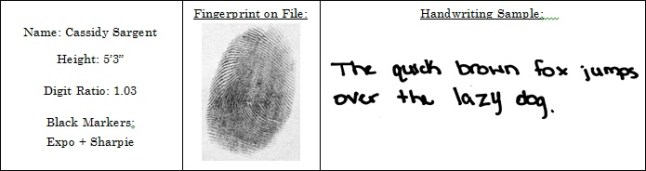
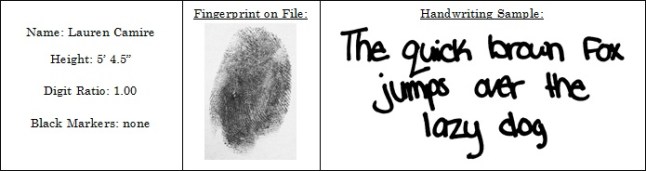
After planning their essays, students then chose roles for tomorrow’s Mock Trial, which will serve the dual purpose of being a fun exercise in real-world science, as well as helping them review before writing their essays… not to mention deciding the guilt or innocence of their beloved classmates!
Fingerprint Databases
At the end of yesterday, we had plenty of dark brown fingerprints, but they were mostly meaningless. As Jake Jackson put it, “You could have all the fingerprints in the world, but they don’t mean much by themselves.” What you need is something to compare them to. What you need is a Fingerprint Database.

Today students learned about the traditional methods of fingerprint classification and then they made a database of all of their classmates’ fingerprints. Each student donated a right thumbprint, and then the each student classified the features they observed. By the end of class, we had narrowed our list down to include only a few suspects.
December 16 – Fingerprint Patterns (pg326)
December 16 – Fingerprint Database (pg327)
Crystal Iodine Fingerprinting
Today in class, students learned how to develop invisible fingerprints using crystal iodine. It turns out that iodine crystals (I2) react with the oils on human skin, which can reveal hidden fingerprints on paper or other surfaces.
However, you can’t just go to CVS and buy iodine crystals. So today in class, we learned how to make them. By combining potassium iodide (KI), hydrochloric acid (HCl), and hydrogen peroxide (H2O2), we created a chemical reaction. And one of the products of that reaction was a heap of gray iodine crystals, which we captured using filter paper.
Before long, all of the students had dark brown fingerprints that were clearly visible. But there was still a problem. Although we could see the fingerprints clearly, no one knew who in the class they belonged to! It turns out that fingerprints are pretty useless without some sort of database for comparison… and that is tomorrow’s lesson!
Ink Chromatography
Today in class we moved on to the next phase of our forensics investigation: ink chromatography. The basic idea is that it can be useful to find out the specific brand of pen or marker that a criminal used. For example, if the police figured out that Hitler’s famous diary was written in ink that was only a few years old, they might be able to determine that the document was a forgery. In fact, this was exactly what happened in the 1980s with the famous Forged Hitler Diaries.
In our lab today, students tried to determine which brand of black marker the hacker used. By exposing samples of ink to a mixture of water and rubbing alcohol, we were able to observe that the ink that was used had a high retention factor and was actually made of a combination of blue ink, green ink, and other dark colors.
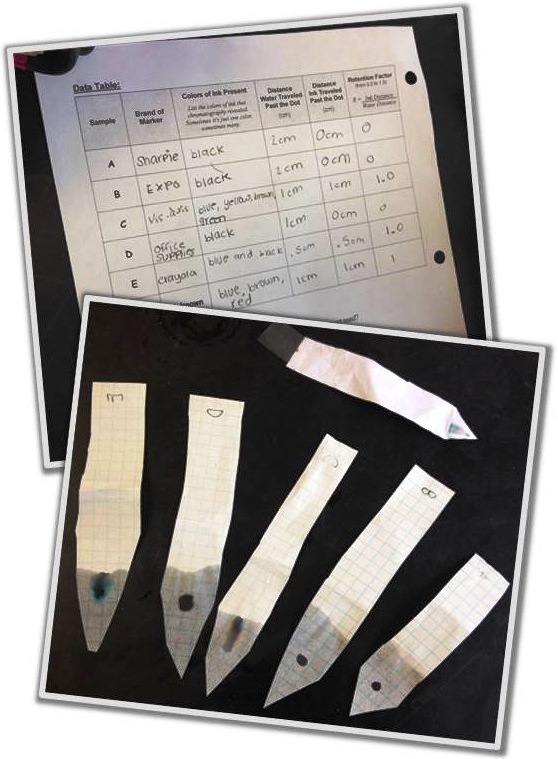
We then tested five different brands of black marker (Expo, Sharpie, Crayola, Vis-a-Vis, and Office Supplies) to see if any of those common brands matched the type of ink that was used by the hacker. Most groups concluded that the marker used was a Crayola, although a few students thought it may have actually been a Vis-a-Vis.
 www.MrAscience.com