Global Warming Lab

Today was our second day investigating the issue of Global Warming. Students worked in groups of four to simulate how thickening the atmosphere with pollution can cause a planet to heat up, even if the amount of sunlight never changes.

GWL2

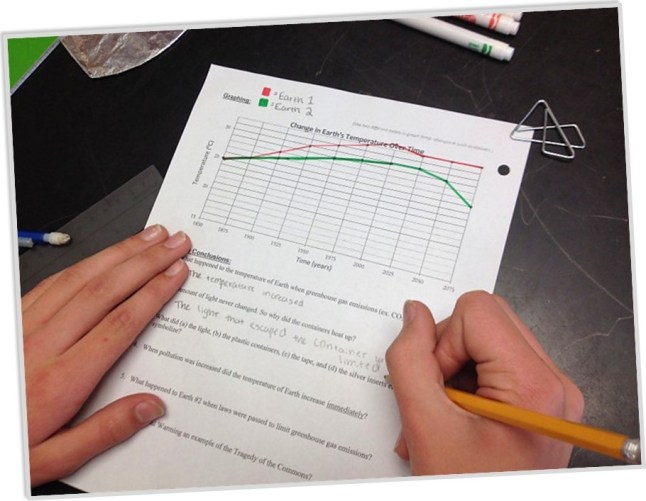
Students read event cards that went from 1850 to 2075. Every 25 years they were instructed to either add or subtract pollution from their “Earths” (clear plastic boxes) and then keep track of the changing temperature. Simply by covering a few of the holes in their boxes with masking tape, it quickly became apparent that temperature does not just depend on the heat source; it depends on the atmosphere too.
GWL

Luckily, for one of the Earths, laws were passed to limit greenhouse gas emissions, and the temperature went back to normal. But for the other Earth that kept on polluting? Goodbye, ice caps. Hello flooding.

May 9 – Global Warming Lab (pg705)

MCAS Review

Regular science classes were cancelled today because students were reviewing for the Science MCAS Test. Unit 7: Environmental Science will continue on Monday, May 9th.

MCAS Review

Regular science classes were cancelled today because students were reviewing for the Science MCAS Test. Unit 7: Environmental Science will continue on Monday, May 9th.

MCAS Review

Regular science classes were cancelled today because students were reviewing for the Science MCAS Test. Unit 7: Environmental Science will continue on Monday, May 9th.

MCAS Review

Regular science classes were cancelled today because students were reviewing for the Science MCAS Test. Unit 7: Environmental Science will continue on Monday, May 9th.

The Problem With CO2 Is…

Carbon dioxide (CO2) may be thickening the atmosphere and warming the planet, but it’s not evil. In fact, it’s part of what makes the planet a nice, livable temperature. The problem with CO2 is…

Today, students did an experiment where they compared the  CO2 content in five different samples of air: indoor air, outdoor air, human breath, air from burning wood, and car exhaust. By injecting the air through limewater, which reacts with CO2, they were able to actually see which samples contained the most carbon dioxide.

Most groups found that — no surprise here! — car exhaust had the highest amount of CO2. And human breath had a lot too. But that doesn’t mean human breath is contributing to global warming. The carbon from human breath comes from our food, which starts off as a plant, which gets its carbon out of the air in the first place! That’s no problem at all. But when you take carbon that’s been trapped underground for millions of years (oil, coal, natural gas) and you burn it, you are adding greenhouse gases that the living creatures on Earth just aren’t ready for. The problem with CO2 is not that it’s evil, it’s that all of a sudden we have too much! And our warm, comfortable planet is getting hotter by the day.

May 2 – The Problem with CO2 Is… (pg704)