Deforestation Board Game

The third of our Top 5 Environmental Issues is deforestation. According to Professor T.M. Das at the University of Calcutta, an adult tree is worth $193,000 annually. The benefits include oxygen production, pollution removal, and increased soil fertility. So if trees are so valuable, then why have humans destroyed half of the world’s forests? Are we all tree-haters?

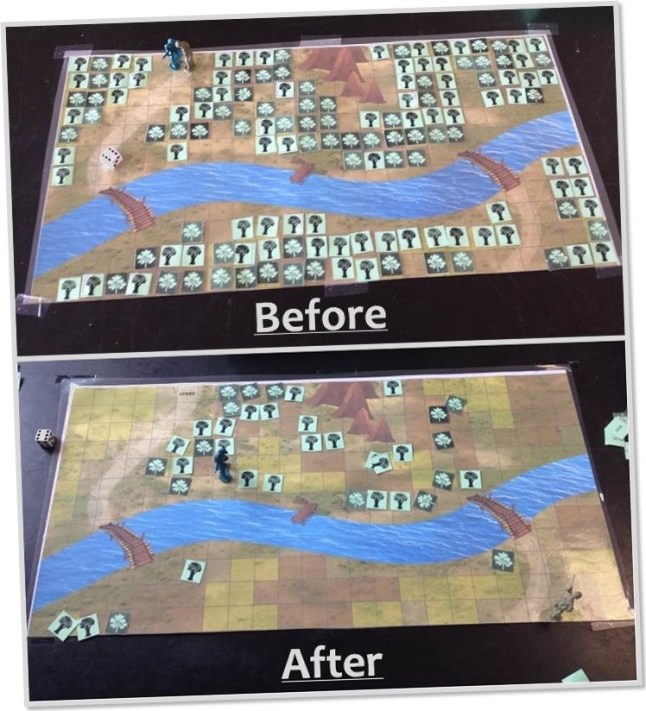
Today, students played a board game in class. Their goal was simple: win the game by making the most profit. Students took turns rolling dice, moving their game pieces around the board, and cutting down trees. On the back of each tree was the earned value of that tree’s lumber. Every 50 years (5 rounds of the game), students paused to regrow the forest. Just like in nature, small patches of cleared forest regrew quickly, while larger patches regrew slower or not at all. Of course, the result of the game was severe deforestation.dfbg
Deforestation isn’t a symptom of tree-haters running wild through Earth’s forests. It’s an example of the Tragedy of the Commons. When someone cuts down a tree, the benefits (the value of the lumber, the paper, or the land) go directly to that individual. And the negative effects (less oxygen, more CO2, less soil fertility, etc.) are spread out. So how do we solve the problem and stop deforestation? That’s tomorrow’s lesson.

May 18 – Logging In the Amazon Lab Day 1 (pg710)

A Year Outside…

Back in August, I began a small science experiment. I buried five different objects in the ground outside my classroom, with the intention of digging them up at the end of the school year. Now, we can put our knowledge of waste and litter to the test. A Styrofoam lunch tray. A plastic grocery bag. A water bottle. A piece of paper. An apple core. What followed would be a test of evolution-meets-environmental-science. Which objects would decompose? Which objects would the microorganisms in the soil even recognize?

ayearoutside

Today, when we dug them up, the lessons that we learned last Thursday were confirmed. The objects made from natural materials (the piece of paper and the apple core) were almost totally decomposed. All that was left behind was the sticker on the apple. That’s because organisms like worms, fungi, and bacteria have all evolved alongside these materials; they recognize them, they eat them, and they can digest them.

But plastic and Styrofoam are a different story. The lunch tray, the grocery bag, and the water bottle were all still fully intact. They are made of strong, lightweight materials. And as such, they can remain in the ground for hundreds of years, because no organisms have yet evolved to break them down. So the next time you are tempted to use a Styrofoam lunch tray, think twice. That tray will still be polluting the Earth when you and I are dead and buried.

A Year Outside…

Back in August, I began a small science experiment. I buried five different objects in the ground outside my classroom, with the intention of digging them up at the end of the school year. Now, we can put our knowledge of waste and litter to the test. A Styrofoam lunch tray. A plastic grocery bag. A water bottle. A piece of paper. An apple core. What followed would be a test of evolution-meets-environmental-science. Which objects would decompose? Which objects would the microorganisms in the soil even recognize?

ayearoutside

Today, when we dug them up, the lessons that we learned last Thursday were confirmed. The objects made from natural materials (the piece of paper and the apple core) were totally decomposed. All that was left behind was the sticker on the apple. That’s because organisms like worms, fungi, and bacteria have all evolved alongside these materials; they recognize them, they eat them, and they can digest them.

But plastic and Styrofoam are a different story. The lunch tray, the grocery bag, and the water bottle were all still fully intact. They are made of strong, lightweight materials. And as such, they can remain in the ground for hundreds of years, because no organisms have yet evolved to break them down. So the next time you are tempted to use a Styrofoam lunch tray, think twice. That tray will still be polluting the Earth when you and I are dead and buried.

Toxic Waste

Yesterday, we introduced the topic of Waste & Litter. In particular, our talk centered around man-made plastics and other materials that are negatively effecting the environment. They clog our rivers, they pollute our oceans, and they look pretty darn ugly… but at least they can’t hurt us, right? Wrong. There is a type of pollution that can hurt us. It’s called toxic waste.
toxicwaste

Toxic waste is generally produced by factories, automobiles, and other modern technologies. And although laws help us keep these pollutants in check, they have a bad habit of accumulating in our environment. Meanwhile, cancer rates and the incidence of birth defects have doubled in the past 30 years. This is no coincidence. Recently, a study by Woodruff, Zofa, and Schwartz found toxic chemicals in over 99% of pregnant women.

Toxic waste is yet another way that humans are fouling the environment. But it’s not because we’re bad people. Many of today’s pollutants are left over from 50 or 100 years ago, long before we understood their adverse health effects. But change hasn’t come fast enough. Today, toxic chemicals are still being produced by factories and automobiles. And that’s what makes environmental education so important. The first step to solving a problem is knowing that there is one.

Resources:
May 13 – Toxic Waste (pg709).docx
May 13 – Toxic Waste PowerPoint.pptx

Waste & Litter

“Raise your hand if you’re against littering,” said Mr. A,
“And now raise your hand if you’ve littered before.”

So if no one likes littering, then why is it a problem? Littering is just another example of The Tragedy of the Commons. When you litter, the positive effects (it’s quick, easy, and convenient) go directly to you, while the negative effects (it’s ugly, takes a while to decompose, and is bad for plants and animals) are spread out.

1

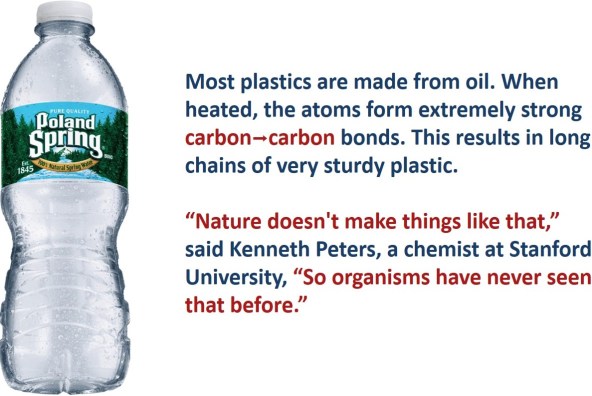
Plastic is a particularly big problem. A simple water bottle, like the one above, will take about 450 years to decompose. Why? Because plastic is a relatively new addition to the biosphere, so plants and animals have not evolved to be able to digest it. Because of that, it can cause long-lasting problems, particularly if it ends up in the ocean.

3

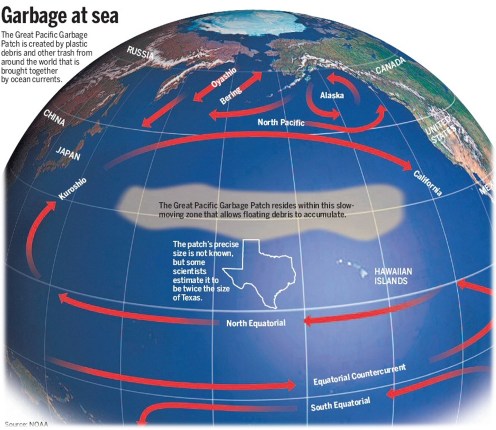
In the pacific ocean, for example, the currents pull garbage created by several different countries into one large patch. The precise size of the patch is difficult to measure, but some scientists believe it to be twice the size of Texas. Because the patch is in international waters, no country takes responsibility for it. And it’s not going to decompose any time soon. So the next time you feel like littering, don’t. Recycle that plastic bottle, or don’t use one in the first place!

May 12 – Waste and Litter Notes (pg 708)

Mercury Rising

Mercury_Rising

After students finished today’s MCAS testing, we did a short lesson investigating one of the effects of Global Warming: sea-level rise.

In reality, predicting sea-level rise is complicated. It includes density calculations, thermal expansion, and modeling sloped shorelines. However, a rough estimate can be obtained using simple geometry. Calculate the volume of ice in Antarctica, divide by the surface area of Earth’s oceans, and you have your answer.

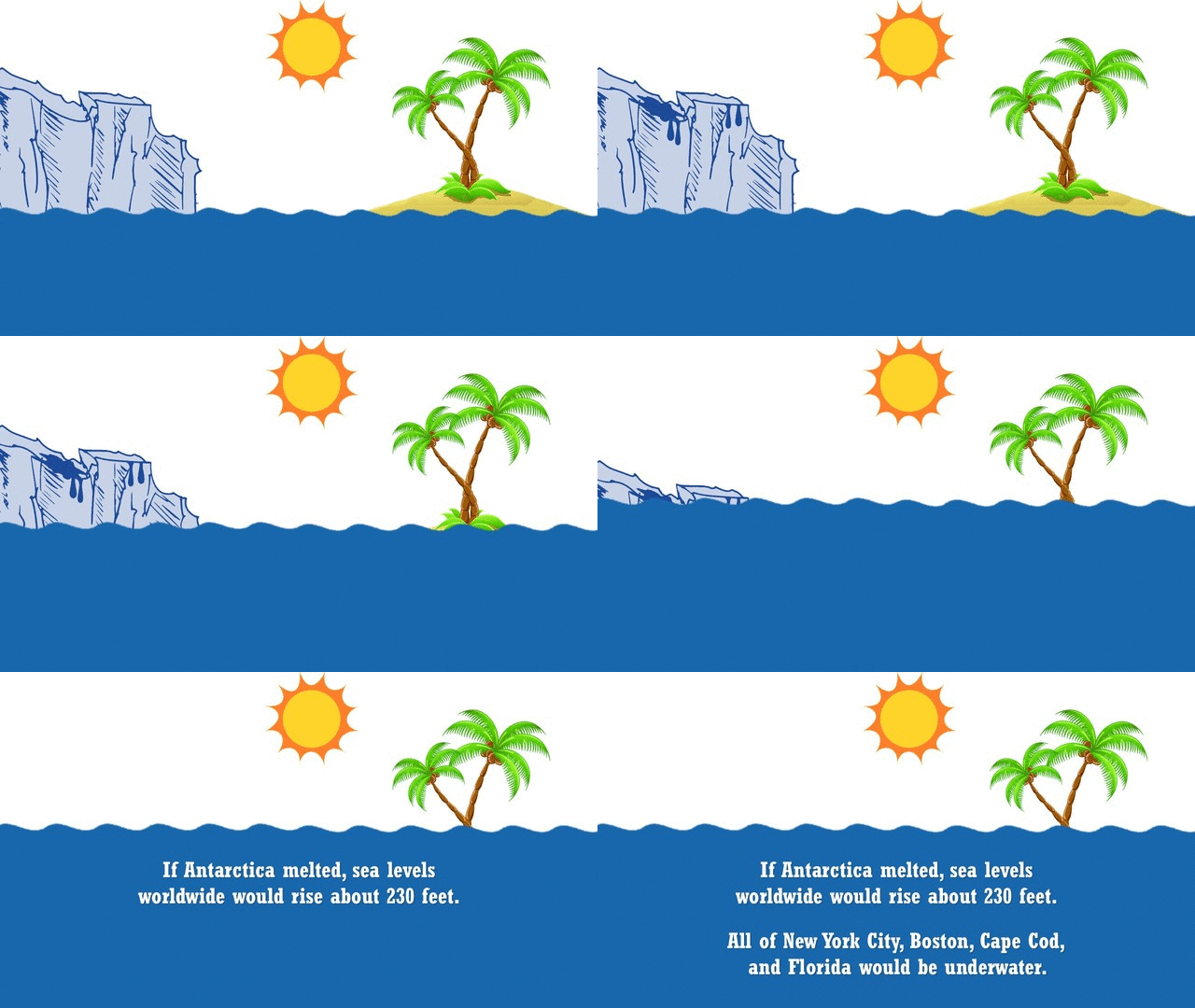
The students found that, if Antarctica melted, sea-levels worldwide would rise about 230 feet. This would mean disastrous consequences for much of the world. In fact, all of New York City, Boston, Cape Cod, and Florida would likely be underwater. This isn’t expected to happen any time soon, given the current warming trends. But it just goes to show you the importance of studying an issue like Global Warming.

May 10-11 – Mercury Rising (pg706)

Mercury Rising

Mercury_Rising

After students finished today’s MCAS testing, we did a short lesson investigating one of the effects of Global Warming: sea-level rise.

In reality, predicting sea-level rise is complicated. It includes density calculations, thermal expansion, and modeling sloped shorelines. However, a rough estimate can be obtained using simple geometry. Calculate the volume of ice in Antarctica, divide by the surface area of Earth’s oceans, and you have your answer.

The students found that, if Antarctica melted, sea-levels worldwide would rise about 230 feet. This would mean disastrous consequences for much of the world. In fact, all of New York City, Boston, Cape Cod, and Florida would likely be underwater. This isn’t expected to happen any time soon, given the current warming trends. But it just goes to show you the importance of studying an issue like Global Warming.

May 10-11 – Mercury Rising (pg706)