Because of today’s music field trip, there were only about 30 students present in Orange Cluster. Those who were here watched the film Chasing Ice, an award winning documentary about climate change. Regular science classes will resume on Tuesday. Have a great weekend, everyone!
Blowing in the Wind
Students often ask the question “How many windmills would it take to power Marshfield?” So I answer. And then very quickly comes the followup question “Why don’t we do it?”
Today, students tried answer that first question for themselves. Wind is an example of kinetic energy (matter in motion). As such, it can be measured using the kinetic energy formula. However, because the mass of air is not easily measured, we typically use a specialized version of the formula:
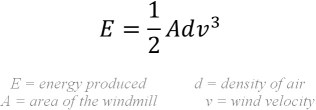
Using that formula, we can fairly easily estimate the amount of energy produced by a windmill. And answering the rest of our question becomes rather simple. We just need to know (a) How much electricity does Marshfield need? (b) How big are the windmills? and (c) How fast is the wind blowing? After working through the problem the first time, students were discouraged. It would take 346 wind turbines to power our town? But wait a minute. Don’t we put wind turbines way up in the sky? And isn’t it much, much windier up there?

Students then worked through the problem a second time. But this time, they used a map that showed Marshfield’s average wind speeds at a height of 70 meters (close to the height of a typical windmill). This changed their answer significantly. Windmills generate much more energy at higher wind speeds; every time wind speed doubles, the energy produced increases by a factor of eight! It turns out that the town of Marshfield would only need…
If you’re looking for the answer, you won’t find it here. The answer, my friend, is blowing in the wind.
Unit 7 Vocab
Because of the erratic schedule for Tuesday and Wednesday this week, students took a pause today to work on their Unit 7 Vocabulary. If you’d like to see the answer key, please click the link below.
Unit 7 Vocab
Because of the erratic schedule for Tuesday and Wednesday this week, students took a pause today to work on their Unit 7 Vocabulary. If you’d like to see the answer key, please click the link below.
Dirty Energy
Where does the world get its energy? We use it for our cars, we use it to heat our homes, we use it to make electricity. But where does it come from? Unfortunately, about 85% of our energy comes from dirty, polluting sources.
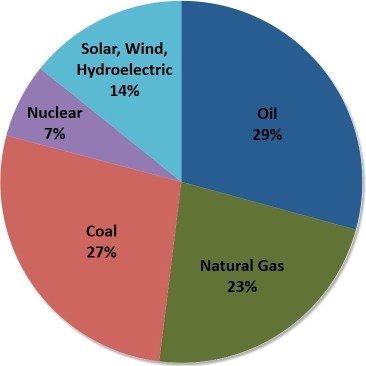
Now the question is, why? Why do we use sources of energy that create cancer-causing sulfur dioxide and release carbon dioxide that warms our planet? Most people would say, “Because it’s cheaper. Powering homes with a coal power plant is cheaper than building a solar farm.” But is it really?

When you look at the cost per megawatt, coal is cheaper. But when you look at the costs including pollution, it’s no contest. Solar wins in a landslide. The problem is that pollution is released into the air where it is spread around. And so are the negative effects. Increased cancer risk and global warming affect everyone, while the benefits of cheap electricity go directly to whoever pays for the power plant. Sound familiar? Dirty Energy is yet another example of the Tragedy of the Commons.
Board Game with Laws
So how do you solve deforestation? Should we stop using paper? Should we stop building houses made of wood?
Of course, reducing our use of paper and recycling can help. But really this issue comes down to managing the forests better, through the use of something called “sustainable forestry.” When large patches of forest are clear-cut, they take ages to grow back. But when only small patches are cut down, the soil, the shade, the seeds, and the rest of the ecosystem are preserved. Using this strategy, forests will grow back in 30-40 years, rather than 300-400 or more.
Today in class, students were asked to play the board game again. But this time, they were encouraged to use sustainable forestry practices through the addition of a new law: for every tree that did not grow back by the end of the game, students were fined $175. In most cases, this was all the encouragement they needed. Instead of clearing large swaths of land, students zigzagged their way across the forests, cutting only small patches and leaving the ecosystem intact, so it could regrow.
It’s not a perfect solution. Students made a bit less profit than they did on Wednesday, and the game moved a bit slower. But the squirrels will thank us, and so will our grand-kids.
May 20 – Logging In the Amazon Lab Day 2 (pg712)
Deforestation Notes
“Deforestation is the permanent destruction of forests in order to make the land available for other uses. An estimated 18 million acres of forest, which is roughly the size of the country of Panama, are lost each year” (United Nations FAO, 2015).
So why do we do it? Why do we clear large areas of forest, so large that they will take ages to grow back? Why do we use resources faster than nature can replenish them?
Put simply, deforestation results from a lack of education and a lack of teamwork. It is yet another example of the Tragedy of the Commons. Without an educated populace, and without laws that ban practices like clear-cutting, deforestation can trap a nation in a cycle of poverty. One only has to look at the border between Haiti and the Domincan Republic to see an example.
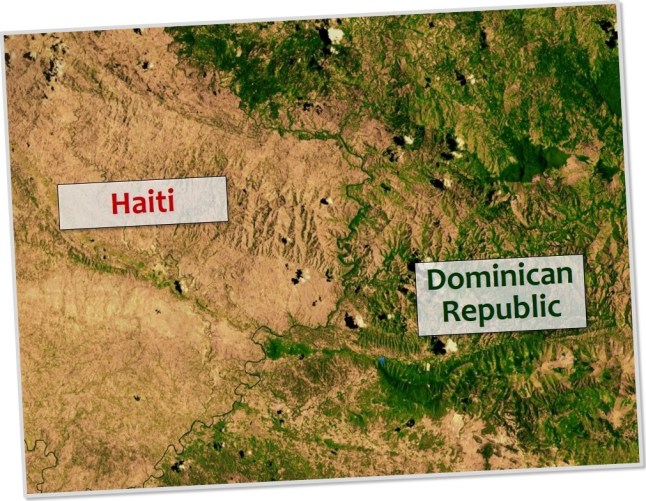
The long-term effects are scary as well. Not only does deforestation lead to poor soil quality, less oxygen, and fewer homes for animals, it also exacerbates Global Warming. Trees are natural carbon-dioxide-removers. Without them, more greenhouse gasses fill the atmosphere, and the planet heats up. So what is the solution? It can be as simple as fining logging companies for trees that they don’t replant, or reducing the use of paper products in our daily lives. Or we could all just hold our breath.
 www.MrAscience.com