Applying for Jobs (Day I)

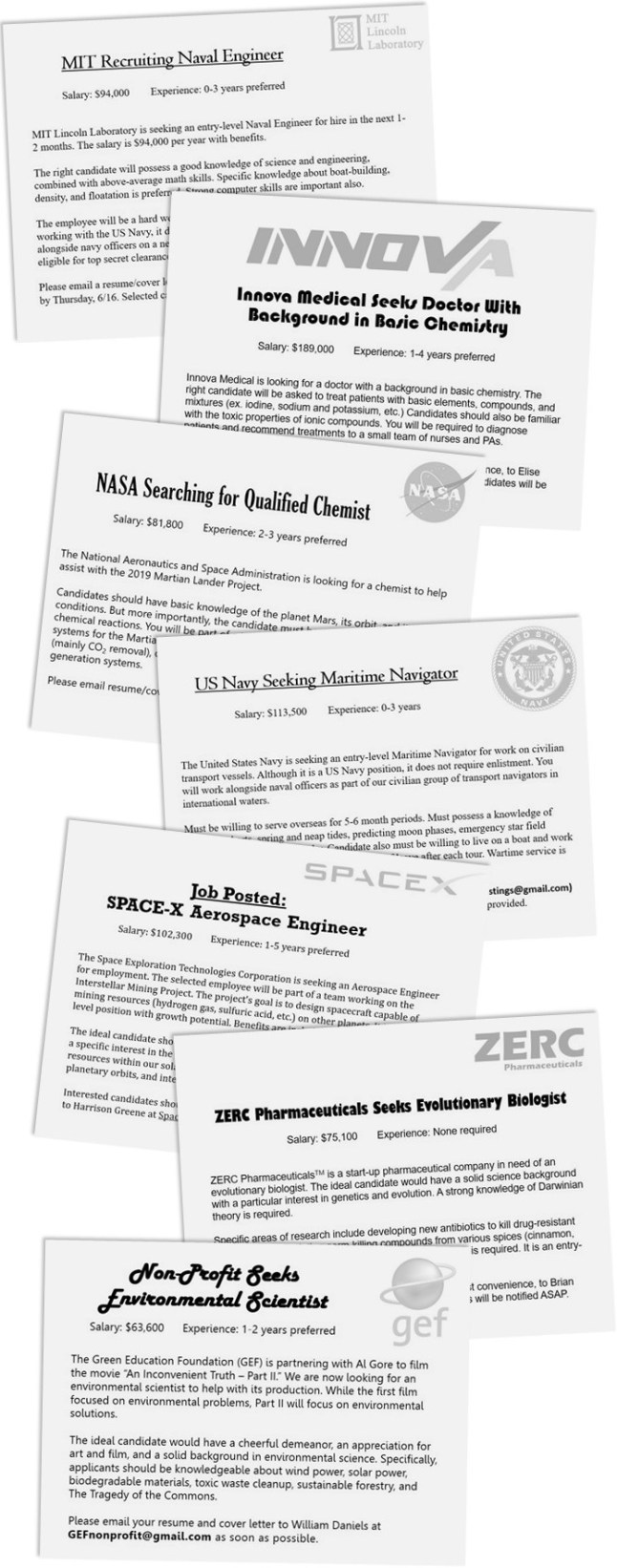
Today, we began our end-of-year capstone project: Applying for Jobs. Students will have to choose between seven different science jobs, one for each of the units we’ve studied this year.endofyearcapstone

Over the course of the week, students will be writing resumes and cover letters and applying for one of the seven jobs above. On Thursday, their resumes will be sent to real science professionals in each of the seven fields. The experts will then choose one winner for each position. Winners will be announced on Friday, and prizes will be awarded!

June 13 – Applying for Jobs (pg720)

Unit 7 Test

Today was the Unit 7 Test, our final test of the year. Congratulations! For the next three days, our 8th Graders will be on a field trip in Washington D.C. We will begin our end-of-year project on Monday. Have a safe trip, everyone!

An Inconvenient Truth (Day 1)

Today we began our Unit 7 capstone, an award-winning documentary called An Inconvenient Truth. The film does a great job linking the five environmental issues we have studied. It also provides a snapshot of where the country was 10 years ago (the film was released in 2006) and how far we have come. Students who missed class can watch the first half of the movie above.

Overpopulation Lab

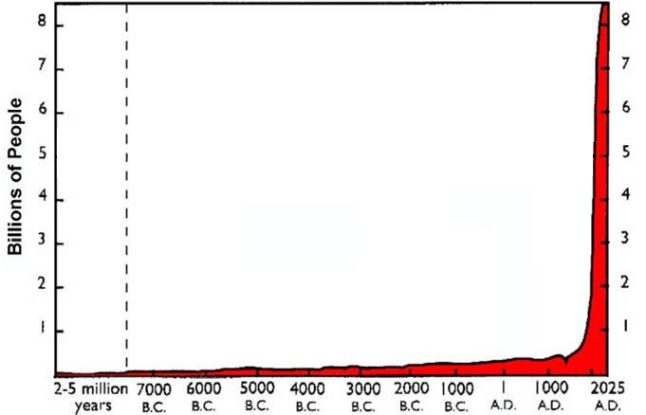
Throughout history, human population was relatively low. It took until 1850 to reach a population of one billion humans. Then, in the course of only five generations, we went from 1 billion people to 7 billion people!

worldpopulation

So how could a problem like this sneak up on us — as if it were possible for 7 billion people to sneak up on anything! — so suddenly? Of course, the industrial revolution and modern medicine played a huge role, but the answer also lies in basic mathematics.

Today in class, students took part in a simulation that modeled population growth. They used dice to play the role of reproducing humans; if they rolled a 1, it meant that a person died; if they rolled a 5 or a 6 it meant that a person had a child. Just like in real life, the birth rate was roughly double the death rate. During each decade, they rolled dice for each member of their population. Before long, a population that started with only six members was well into the hundreds. In fact, if this simulation were carried out further, a population of six would reach about 7 billion after only 136 generations. I guess we’re going to need some more dice…overpopulation lab

June 1 – Overpopulation Lab (pg716)

Overpopulation

According to Dr. Charles Hall, a systems ecologist, “Overpopulation isn’t one of the problems… it’s the only problem.”

overpopulation

Overpopulation is the environmental problem that makes all of the other problems worse. Global warming, deforestation, waste & litter… none of these would be problems if there were only a hundred of us living on Earth. But there are more than a hundred; there are 7,425,000,000 of us, as of this morning.

It’s not a matter of if, but when. When will Earth be full? Can it support 9 billion humans or 10 billion? When will we begin to run out of resources? Garrett Hardin touched upon this in his famous essay, The Tragedy of the Commons, saying “Human population will eventually need to stop growing. And when this occurs, what will the situation be for mankind?”

Do we want to live on a planet that’s full, with barely enough food, water, and space to support us? Or instead, should we be forward-thinking and solve the problem now? Should we perhaps pass laws or prioritize the education of women? The choice is ours.

May 31 – Overpopulation Notes (pg714)
May 31 – HW Stand Up for the Environment (pg715)

Tonight’s HW requires you to listen to five different stand-up comedy performances. The first is by Larry David, the second is by Gary Gulman, the third is by Arj Barker, the fourth is by Jerry Seinfeld, and the fifth is by Louis CK. To listen, please click the preceding links.