Sir Isaac Newton


Summary:

We began today by playing a game called “Three Scientists.” Of course, three of the most famous scientists would have to be Albert Einstein, Charles Darwin, and Sir Isaac Newton. During the game, students had to reach into a box and pull out a scientific discovery. For example, they might pull out a card that says “Invented Calculus.” Then the student, with help from their classmates, had to figure out whether this was a discovery of Einstein’s, Darwin’s, or Newton’s.

At the end, I showed them the correct answer (see video above). The lesson? Sir Isaac Newton was brilliant. After taking a few minutes to appreciate the breadth of Newton’s discoveries, we took notes on Mr. Newton using the PowerPoint below.

Resources:
Three Scientists Cards.pptx
September 8 – Sir Isaac Newton (pg106).pptx

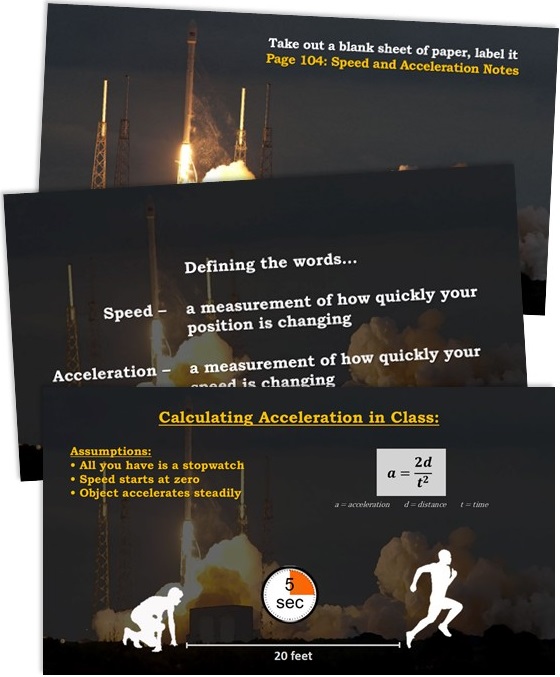
Calculating Speed and Acceleration


Summary:

Today, students practiced using the formulas we learned yesterday. Students took turns running, walking, jogging, and rolling across the classroom. We measured the distance and time for each student and then either calculated their speed or acceleration. I tried to mix in different units (ft/s, m/s, m/s2) to make sure they are familiar with a variety of examples. But really this was a day about practicing the formulas.

formulas

Resources:
September 7 – Calculating Speed and Acceleration (pg105).docx

What Is Mass?

mass

Summary:
After utilizing my “It’s not just a Sunday ritual for Catholics!” joke, we started off with a discussion of the term mass. We defined it as “the amount of matter in an object.” I like to explain that if you were able to chop up an object and count up all of the individual atoms, that would give you an idea of how much mass that object has. After the definition, I showed some examples (baseball vs. Styrofoam ball). We discussed how mass is slightly different from weight. Then we talked about how to measure mass and what units scientists use. For the last half of class, students practiced using a balance to measure the mass of various objects in grams, kilograms, and milligrams.

Resources:
September 5 – Mass (pg103).docx
September 5 – Answer Key.pdf

Water, Water Everywhere


Summary:

In this lesson, students begin our unit on “Forces & Motion” by taking part in a classic water-balloon-throwing competition. They throw the balloon back and forth with a partner, increasing the distance as they go. When the balloon breaks, their team is done. At the end of class we discuss three rules for water balloon throwing. Little do they know, these three rules are actually Newton’s Laws.

Resources:
August 31 – Water, Water Everywhere (pg102).docx
August 31 – Answer Key.pdf

Decorate Binders

Decorate Binders

Summary:
At the beginning of the year, I like to start with a few easy lessons, and this is one of them. Students decorate their binders with pictures representing each of the seven units we will study this year. This is a fun way to get them started with keeping their binders neat and organized, and it’s also a good preview of what is to come this year.

Resources:
August 30 – Decorate Binders Shapes.pptx

Extra Lessons (Unit 7)

U7Extra (1).
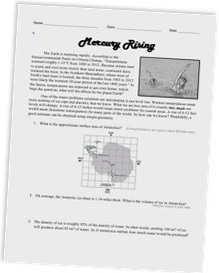
A math lesson where students use basic geometry to estimate
how much sea levels would rise if Antarctica were to melt.
Click here to download.

.

.U7Extra (2)
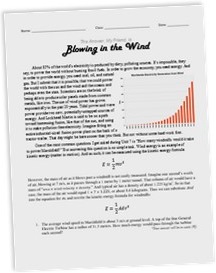
A math lesson where students use the kinetic energy formula
to determine how many windmills it would take to power
the town of Marshfield. The answer? Fewer than you think.
Click here to download.

U7Extra (3)
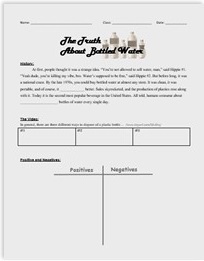
Students learn about the pros and cons (and more cons)
of bottled water, and conduct a taste test to answer the
fundamental question: Does it actually taste better?
Click here to download.

U7Extra (4)
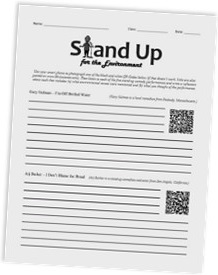
Students listen to five different stand-up comedy bits, all
concerning the environment, and are asked to discuss each one.
Click here to download.