Seasons Lab

.
Summary:

After yesterday’s lecture on seasons, today it was time to apply what we learned. Students completed the Seasons Lab (posted below). They used a flashlight to simulate the sun and used graph paper to simulate Earth’s surface. As the angle of the graph paper was increased, as in winter, the light became more and more spread out. Of course, this is what causes the winter drop in temperature; the sun’s energy is spread out over a large area, so it feels weaker. Students traced the area that was illuminated by the flashlight, counted up the number of squares that were lit up, and then calculated the number of watts per square. They completed the post-lab below for homework.

Resources:
February 14 – Seasons Lab (pg507).docx
February 14 – Seasons Post-Lab (pg508).docx
Seasons

This slideshow requires JavaScript.

Summary:
We moved on to a new topic today: seasons. We went through a PowerPoint presentation (posted below) that started off with a diagram of the sun, Earth, moon system — not to scale! Then we added in the Earth’s orbit, its rotation, and also its tilt, which was a new addition to yesterday’s model. Then we discussed how the increasing the angle of incoming sunlight can make it much less powerful. Putting all of this together, the reason for the seasons became obvious. It’s not because of the gods or because of our changing distance from the sun, it’s because of Earth’s tilt.

Resources:
February 13 – Seasons Notes (pg506).pptx

Sun, Earth, Moon Diagrams

.
Summary:

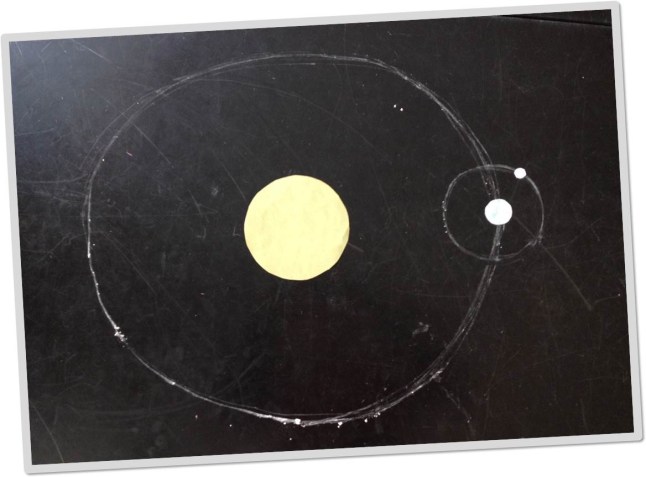
Today we had a competition where students had to build a scale model of the solar system on their desk. Or not the whole solar system — that would have taken forever! — but rather a model of the Sun-Earth-Moon system. Students were given a yellow sun roughly the size of a softball and they had to cut out circles of paper that showed the correct size of the Earth and moon, relatively speaking. Then they had to place them at the correct distance away from the sun and sketch out the motion of each object as well.

SEMmodel

Afterwards, we corrected our work. And the true answer defied expectation. Given our scale (the sun = 13 cm), the Earth would have roughly the same diameter as your pencil lead (0.12 cm) and the moon would be roughly the size of a grain of sand (0.03 cm). Not only that, at that same scale, the Earth and sun would have to be placed 46 feet apart! And what lies between is the vast, empty expanse that we call “space.”

Resources:
February 12 – A Sun, Earth, Moon Model (pg505).docx
February 12 – Paper Cut-Outs.docx
February 12 – Sun, Earth, Moon Answer Key.pptx

Gravity Drop Lab

.
Summary:

Today students completed the Gravity Drop Lab. In the experiment we tried to prove that (a) gravity causes objects to accelerate and (b) gravity affects all objects equally. Students dropped a heavy metal marble and a lighter plastic marble through a photogate from varying drop heights. Then they calculated the speed at which the marble was falling. By doing this, they noticed two things. First, the higher the drop height, the smaller the time through the photogate — the marble was falling faster! And second, it didn’t matter that one marble was five times heavier than the other, they both fell at the same rate — Earth’s gravity affects all objects equally!

Resources:
February 9 – Gravity Drop Lab (pg504).docx

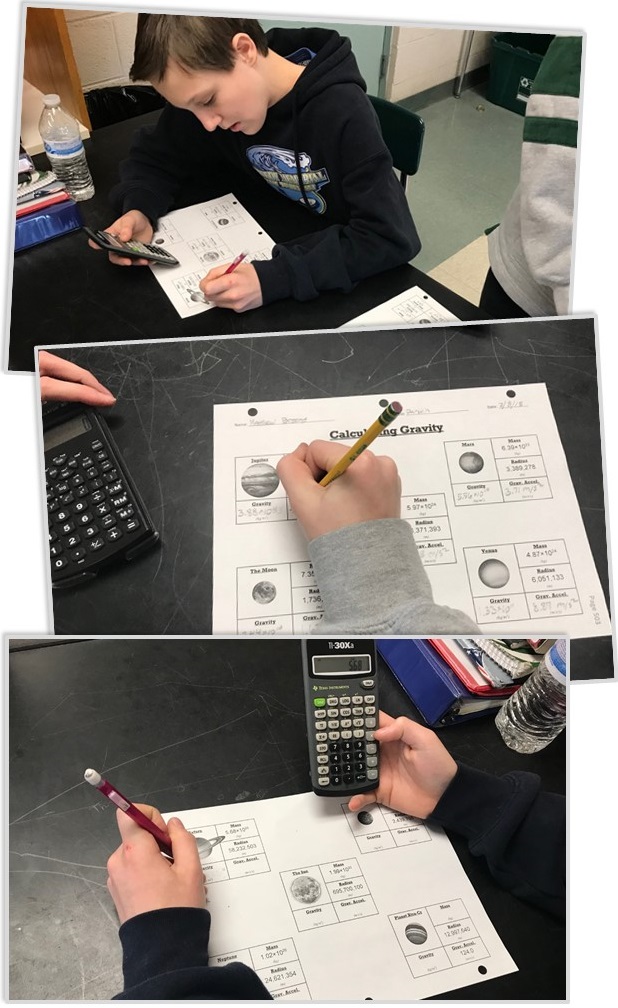
Calculating Gravity

CalcGrav

Summary:
Today was one of the hardest lessons of the year: calculating gravity. Students practiced using Newton’s equation (g=m/r2) to calculate the gravity of various planets in the solar system. They plugged in the mass (in kilograms) and divided by the radius (in meters) squared. Then they got their answer, but it was in some very strange units. So they multiplied by Newton’s gravitational constant (6.67×10⁻¹¹) in order to convert the units into the more useful form: m/s2. It was difficult day for students. But after a full period of practice, most of them were getting it.

Resources:
February 8 – Calculating Gravity (pg503).docx

Gravity

GravityNotes

Summary:
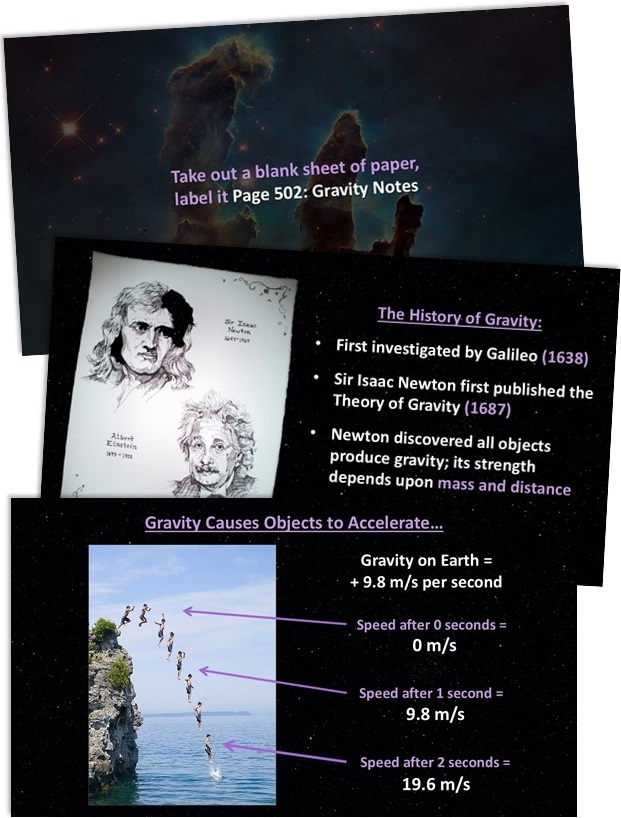
After a nice soft introduction to astronomy yesterday, today’s lesson hit students a bit harder. We went through a PowerPoint (posted below) that introduced the topic of gravity. We discussed what it is, how it is different on different planets, and what it does to an object. Lastly, we discussed how gravity is the same for all objects. When you remove air resistance, literally or figuratively, it turns out that all objects on Earth accelerate equally. (This makes sense; the force of gravity comes from the Earth, not the object). And the acceleration comes out to a very famous number: +9.8 m/s per second.

Resources:
February 7 – Gravity Notes (pg502).pptx

Astronomy Myths

This slideshow requires JavaScript.

Summary:
To begin our astronomy unit, we started off with a lesson on astronomy myths. These were ancient explanations for very familiar observations like night and day, the tides, shooting stars, and eclipses. Students were asked to read the old myths (posted below) and to try to figure out what the heck these old cultures were writing about. Then they were asked to come up with the modern name for each phenomenon and, if they finished early, to discuss the modern explanation for each phenomenon. My hope is that, by the end of Unit 5, every student will be able to explain every one of these myths. We’ll see…

Resources:
February 6 – Astronomy Myths (pg501).docx
February 6 – Astronomy Myths Cards.docx